
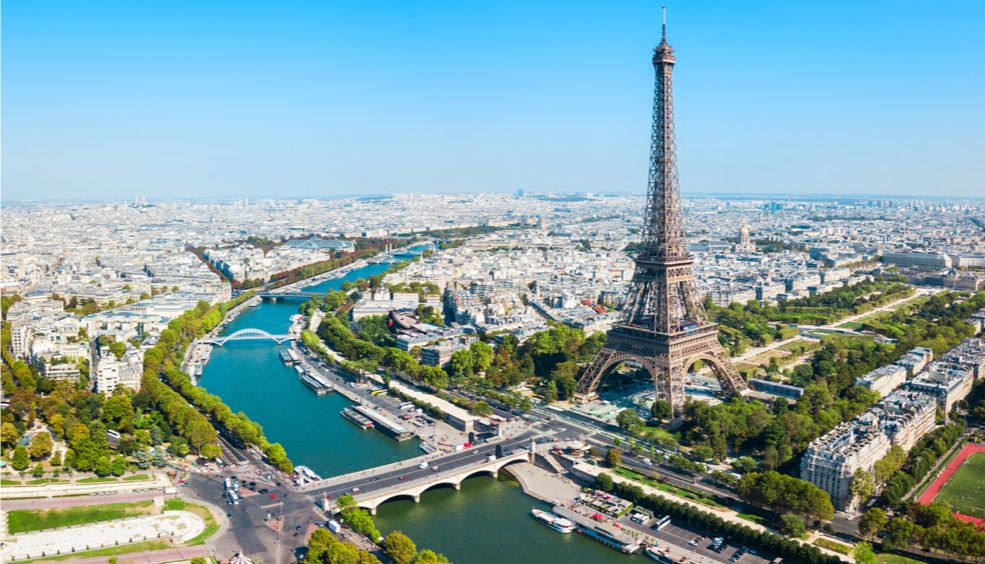
These are Vueling’s new routes to Paris-Orly
New routes connecting Paris with Spain, Italy, UK, Denmark, Germany, Norway, Sweden, Ireland, Morocco and Malta, since November 2021.
more info
Alternative Prague
On account of its historic legacy, Prague is a jewel sculpted by the passage of time and one of the leading tourist destinations. If you happen to be in the capital of the Czech Republic, you are bound to visit its popular castle, cross the well-known Charles Bridge and have a revitalising Pilsner in any of the city’s myriad beer halls. But, when you are done with the typical tour for flip-flop and sock-wearing guiris, set off to explore the Prague which Czechs usually keep to themselves. This is the city, as fascinating as it is alternative, which we reveal in the following.
David Černý
David Černý has turned Prague into his own huge museum. A St Wenceslas on an upside-down horse, a statue of two men peeing facing each other, Freud hanging from a building, babies transformed into machines… These are but some of the works which the most widely acclaimed yet corrosive and controversial contemporary Czech artist has strewn about the streets, avenues and public spaces of the Czech capital.
DOX
DOX is housed in a refurbished building in the working class suburb of Holešovice. Inaugurated in 2008, Prague’s contemporary art centre boasts the largest collection of modern works in the country. This is a must-visit venue for all art lovers. We recommend you end the visit by making a foray into their interesting shop – their café is nothing to scoff at either.
The Dancing House
Originally known as Fred and Ginger, in honour of the famous dancing couple, it was eventually named The Dancing House. This construction with its fascinating curved forms is highly conspicuous in a city celebrated for its centuries-old buildings. It was designed by Frank Gehry, the architect behind Bilbao’s Guggenheim Museum, who executed the project in collaboration with the Croatian-Czech architect, Vlado Milunić.
Malá Strana
The Malá Strana district is a refuge for the inhabitants of Prague when inundated by droves of tourists. A backwater of calm and quiet in the heart of the city, it is bounded by several green areas, notably Kampa Island. The latter is separated from Malá Strana by a channel popularly known as the Devil’s Stream and its basks in bucolic beauty all year around. It is the ideal spot to get away from it all and to enjoy a stint of reading while sipping a coffee in one of the inviting cafés secreted along its streets.
Náplavka
This spot in the south of Prague’s Old Town, on the right bank of the river Moldava, was once the major meeting place of hippies. It has now become the focal point of hipster Prague. The area has a thriving art and culture scene and the best time to visit is on Saturdays, when the so-called Farmer’s Market is held from ten in the morning until nine in the evening. It is devoted to regional farm products, with stalls selling organic produce, craft beer and street food. You are likely to even gobble up the paper serviettes (recycled ones, of course).
Cubist Prague
When it comes to Cubist art, what normally springs to mind are works by such figures as Pablo Picasso, Georges Braque, Jean Metzinger and Juan Gris. And, if we push it a little further, the sculptures of Alexander Archipenko, Jacques Lipchitz and Henri Laurens, and the literary experiments of Guillaume Apollinaire. However, we hardly ever think of Cubism as applied to architecture which had in Prague once of its paramount expressions, thanks to the architectural trio made up of Josef Chochol, Pavel Janák and Josef Gočár. Visitors can delight in a number of their constructions around the city, but you should make a special point of seeing the building which epitomises the movement, Gočár’s House of the Black Madonna. Located on the corner of Celetná Street and Ovocný Square in the heart of Prague, it now houses the Czech Museum of Cubism.
SoNa
Wallpaper Magazine rated it one of the classiest districts in the world. Indeed, SoNa (short for “South of Národní”) is worthy of that distinction, what with its winding streets, cafés bustling with lively folk and exotic restaurants where you can sink your teeth into specialities from some of the remotest spots on earth. And, if you feel like doing some shopping, wander down Karoliny Svetle, where you will come across the stores of the most avant-garde local designers.
Vyšehrad
No alternative guidebook to Prague would leave out a visit to Vyšehrad, the Czech capital’s “other castle”. Rather than a castle, it is actually a ruined fort. Apart from interest in the landmark itself, Vyšehrad affords some of the finest views of Prague and the river Moldava.
The Alternative Tour
If you’re keen on delving further into alternative Prague, you can get help from Prague Alternative Tours. They will take you through the flip side of the Czech capital, past the walls displaying the city’s most amazing street art and to the flashiest clubs. They will also get you into the most innovative contemporary art galleries, and community centres where you can meet the most promising young local creators.
Book your Vueling to Prague and gear up to discover the alternative side of the Czech capital.
Text by Oriol Rodríguez
Images by Nan Palmero, Marmontel, Jose Mesa, Achim Hepp
more info

Málaga An Art Laden Holy Week Break
Málaga’s Holy Week is among the most popular in Spain. Each year it draws some five million tourists eager to succumb both to the city’s charms and the magical extravaganza of this festivity, a blend of the religious, traditional and cultural. Designated a Tourist Interest Site on 16 February 1980 and dating back to the time of the Catholic Kings, Holy Week in Málaga is an obligatory event for anyone wishing to experience first-hand a unique spectacle, guaranteed to move even the die-hards.
Apart from the traditional features of Holy Week, anyone coming to Málaga at this time of year can take the opportunity to visit some of the numerous museums and art centres here, some of them recently inaugurated, to delight in the plethora of art on display. Following is our selection of the most prominent exhibitions open to the public during the festive week in Málaga.
Picasso Museum of Málaga
The city of Málaga is inextricably linked to the figure of Picasso as it was here that he was born. Part of the art genius’ legacy is preserved here – specifically, the Picasso Museum of Málaga houses 285 of his works, spanning 80 years of his career, from 1892 to 1972. Imperative, therefore, to visit the Buenavista Palace, home to the collection on public display. Those of you who can afford to visit Málaga later on in the year, take note that from 26 April to 17 September you can also see the exhibition, Bacon, Freud and the School of London, a joint endeavour with the Tate Britain.
Carmen Thyssen Museum
Another must-visit collection in Málaga is housed in the Carmen Thyssen Museum. Located in the Villalón Palace, it is essentially a review of the various genres in 19th-century Spanish painting. In addition to the permanent exhibition, during Holy Week you can also see La apariencia de lo real. Cincuenta años de arte realista en España (1960-2010), an exhibition which features a converging perspective between contemporary Spanish realism and the tradition of Baroque naturalism. Another option to consider is the exhibition Japan. Prints and Art Objects, which runs until 23 April and showcases a selection of exhibits from traditional Japanese art, most of them on loan from the Bilbao Fine Arts Museum.
Centre Pompidou, Málaga
Another of the city’s major attractions is the Centre Pompidou, Málaga. Opened in March 2015, its collection provides an interesting journey through 20th- and 21st-century art. Additionally, from 23 March to 23 April, the Centre will be hosting the second edition of Hors Pistes. Entitled Travesías marítimas, this exhibition explores shipping routes and the impact they have had in the field of art and motion images.
Russian Museum Collection
The building which once housed the Real Fábrica de Tabacos de Málaga (tobacco factory) is the site of this magnificent temporary exhibition, on loan from the State Russian Museum of Saint Petersburg. Apart from the annual temporary exhibition devoted to The Romanov Dynasty, until 16 July you can also see the exhibition Kandinsky and Russia, which delves into the Russian period of this forerunner of abstract painting and iconic figure of 20th-century art.
Málaga Museum
One of the more recent additions to a city which is seeing a boom in its cultural offerings is the Málaga Museum, housed in the Neoclassical Palace of La Aduana. Inaugurated on 12 December 2016 after a remodelling project that took 10 years to complete, the Museum has on display 2,200 exhibits of a total of 17,500 making up its two collections. This comprises 2,000 exhibits from the overall 15,000 listed in the Provincial Archeological Museum, and a further 200 out of a total of 2,000 from the Provincial Fine Arts Museum. This is a first for a city which you should make a point of visiting!
Book your Vueling to Málaga and indulge in what promises to be an unforgettable Holy Week, thanks to its emotionally charged processions and the magnificent offerings of its art museums.
Text by Los Viajes de ISABELYLUIS
Images by Epizentrum
more info