

Bilbao BBK – the Northern Spain Festival
Bilbao BBK has been with us for twelve years now – that’s quite a feat. A well consolidated festival which manages to compete with some all-powerful musical events in Barcelona and Madrid within a similar timeframe. The reason for its success is simple – its lineup of artists has been steadily growing in prestige and popular appeal. BBK, which is held this year from 6 to 8 July 2017, features some awesome names. The lineup of markedly varied musical styles is headed by Depeche Mode, Phoenix, Fleet Foxes, Die Antwoord, The Killers, Two Door Cinema Club, Justice, The Avalanches and Brian Wilson, among others. If you want to attend the concerts, there are still available some 3-Day Tickets and room in the campsite, should you prefer to steer clear of hotels and instead be more adventurous.
One of the hallmarks of this festival is the grounds it is set in. Monte Kobetas (also known as Kobetamendi), is one of the city’s iconic playgrounds. This elevated, forested area affords spectacular views of Bilbao, apart from acting as one of its lungs and a spot where Bilbaines do sport and go for picnics. However, the precinct is off limits to the general public for the duration of BBK, when it is repurposed solely to music. Access to Kobetamendi is a simple matter; in fact, a couple of free bus lines are laid on for the event by the organisers, facilitating access to the festival precinct for all attendees.
Over and above the musical offerings, BBK provides the perfect excuse for getting to know other places in Bilbao, too. Here are a few proposals for early risers eager to explore the city on foot.
The Best “Pintxos”
It’s a cliché, but it’s actually true – if you visit Bilbao, you simply have to eat pintxos more than once. It is an unwritten norm. And, Bilbao happens to have some of the best bars serving up this culinary speciality. To score a bull’s-eye with your pintxos, the best thing is to head for the city’s historic centre, an area crammed with restaurants of tried and tested quality. Four of them we can highly recommend are Gure Toki,Txiriboga,Motrikes and Askao Berri.
A Touch of Art
As luck would have it, BBK coincides with one of the pictorial exhibition highlights of the year, which is still on in the Guggenheim Bilbao, namely Paris, Fin de Siècle, an exhibition showcasing the work of the most prominent late-19th-century French and European painters. It would be unthinkable not to dive into the museum to see paintings by Toulouse-Lautrec, Signac and Redo, among others, before going up to the Kobetamendi precinct to soak up the festival. Oh, and while you’re about it, make sure you don’t miss the museum’s permanent collection, featuring works by the likes of Robert Motherwell, Yves Klein, Andy Warhol, Jean-Michel Basquiat, James Rosenquist, Anselm Kiefer and Gerhard Richter.
Power Records – Bilbao’s Temple of Vinyl
When in Bilbao, dropping in on Power Records is almost as important as eating pintxos if you’re a music aficionado.This legendary store has over twenty-five years’ history behind it. Located on Calle Villarías, near the Old Town and the Nervión estuary, this establishment has a mind-blowing selection of vinyls, both second-hand and imported. This is a veritable sanctuary for music lovers hunting for rare records by their favourite groups. Apart from second-hand albums, Power Records is also dedicated to CDs, reissues and the latest releases. So, if that seven-single by Depeche Mode, or a vinyl of “Pet Sounds” by Brian Wilson has been eluding you, you’re probably going to find it here.
Book your Vueling to Bilbao and let yourself be swept away by the music waves of one of the standout festivals in Spain.
Text by Xavi Sánchez Pons
more info
Tel Aviv An Oasis of the Bauhaus
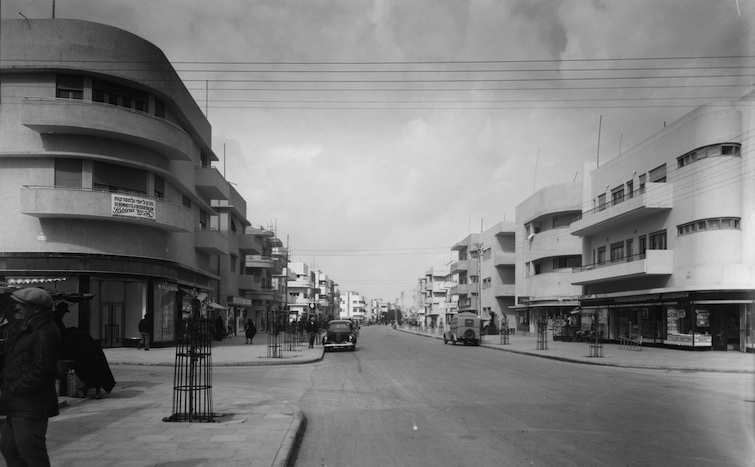
The Bauhaus is to Tel Aviv what Art Deco is to Miami or Modernism is to Barcelona, an unmistakeable identity trait which is the pride and joy of the city’s inhabitants. We came across more than 1,000 buildings in the length and breadth of the city, which stretches for 50 square kilometres.
Bauhaus Comes To Tel Aviv
The relationship between Tel Aviv and the Bauhaus goes back to the 1930s when, coinciding with the rise of the Nazi party, many Jewish architects decided to leave their homeland and try their luck elsewhere. At that time, the future metropolis was a young city with an urge to expand and to tap its full potential. The so-called White City – as the area housing these buildings is known – was built between the early 1930s and 1948 to an urban layout designed by Sir Patrick Geddes, based on the principles of modern organic urbanism. The likes of Walter Gropius, the founder of the Bauhaus in Weimar, and of Arieh Sharon, Shlomo Bernstein and Shmuel Mestechkin, arrived in Tel Aviv and drew up an elaborate, ambitious urban plan which enabled the directives of this style to be adapted to the arid surroundings of the site and to its Mediterranean context. Thus, the light, fresh air of this architecture consorted to perfection with the thirst for renewal and creativity that characterised what would become the new State of Israel as of 1948.
Preservation – A New Challenge
The buildings were designed in light colours – generally white – leaving open-air pillars for the wind to blow unfettered through the lower part of the buildings, while recessed windows were fitted to check the passage of heat. The Bauhaus of Tel Aviv is also characterised by its straight lines, its symmetry and a minimalist style which even today tends to amaze visitors on account of its simplicity and overall character. The fact is that, faced with a new cultural context, those architects designed an exceptional set of buildings which became highly representative of the modern architecture movement.
Despite the large number of such buildings scattered about the city, their state of preservation is somewhat precarious. In fact, over 4,000 of these buildings were originally erected, so many of them clearly did not survive. Hence, concerted endeavours have been under way in recent years to restore over 1,000 extant constructions to their original state. It is a slow, arduous task, as most of them are private property and have not been touched since their completion some 70 or 80 years ago.
The Best Examples In the City
Given the large number of surviving buildings, the best thing is to plan an itinerary before embarking on a search of Bauhaus buildings in the city. Some of the most prominent examples are on the Rothschild Boulevard, and on Bialik and Dizengoff Street, but you are advised to first visit the Bauhaus Center to get the relevant information. They have books and maps on the subject and you can find out about the free tour organised by the City Hall on Saturdays called the Tel Aviv-Bauhaus Walking Tour.
To round off your visit, be sure to visit the Bauhaus Museum on Bialik Street which is useful for gaining insight on the impact which the Bauhaus of Tel Aviv has had on the rest of the world.
Text by Aleix Palau for Los Viajes de ISABELYLUIS
more info
Carcassonne Medieval Inspiration
Set in the middle of a triangle comprising the cities of Toulouse, Montpellier and Barcelona is this spectacular walled city, a captivating sight for all who visit it. Fittingly, it was designated a World Heritage Site by UNESCO in 1997. It is one of the leading tourist magnets in the Languedoc region and the whole of France, attracting around 4 million visitors each year. Here are the reasons why Carcassonne has become a must-visit destination.
Important Strategic Enclave
The city’s strategic location, set as it is on a hillside overlooking the Aude river valley, made it the perfect vantage point for surveilling such important routes as the one linking the Iberian Peninsula to the rest of Europe, and the Atlantic to the Mediterranean. Thus, Carcassonne became a key city for centuries. In Roman times it was already an important trading post and was coveted by Gauls, Romans – who built the first walled fortifications – Visigoths and Moors, until it ended up becoming a French royal army garrison.
A Walk Through the Cité
Vestiges of that illustrious past as a strategic bulwark can be seen in the upper city of Carcassonne, now known as the Cité, site of the old walled fortifications. Sightseers touring the interior of this huge walled precinct are immediately transported to a bygone era. The Cité is fortified by two concentric walls – the innermost ring was erected in the times of the Gauls, Romans and Visigoths, while the outer, far sturdier ring with four towers was added from the 13th century onwards. Once inside, visitors are encouraged to stroll through the city streets and soak up the medieval atmosphere that pervades the complex. The major landmarks here are the Château Comtal (Castle of the Counts), in the west of the fortified city and attached to the wall, and the Romanesque Basilica of Saint-Nazaire. Be sure to also visit the Pont Vieux (Old Bridge) which crosses the Canal du Midi and links the Cité to the lower part of Carcassonne.
Some Extras On the Way
The counterpoint to this journey into the past, which takes you through the streets of medieval Carcassonne, finds its ideal complement in a culinary break in one of the restaurants you will come across on your tour. Treat yourself to a good glass of wine, preferably Corbieres, the local Designation of Origin, accompanied by duck confit or cassoulet (a local bean stew). The best way to round off your visit to this city.
Viollet-le-Duc – The Other Great Protagonist of Carcassonne
Much of Carcassonne’s appeal revolves around the figure of French architect, archaeologist and writer, Viollet-le-Duc and the “restoration”, as unique as it was controversial, which he carried out on the Cité in the mid-19th century. The fact is that, following the Treaty of the Pyrenees in 1659, the fortified precinct of Carcassonne was abandoned altogether and gradually deteriorated with the implacable passage of time. Indeed, it was so derelict that some voices called for its wholesale destruction. However, by popular request, it was earmarked for refurbishment, a task which was commissioned to one of the leading figures of the moment, Viollet-le-Duc.
Rather than what would now be considered a refurbishment, visitors currently find themselves before a full-blown reconstruction of the old city, including the odd flourish of a Romantic bent added by Viollet-le-Duc himself. He actually applied what was very much in vogue in restoration work at the time, although his endeavours have subsequently drawn considerable criticism from the experts. However, the result admittedly hangs together rather well and achieves the effect of immersing the visitor in a medieval past which the architect purposely set out to reinterpret.
Book your Vueling to Toulouse, which lies less than 100 kilometres from Carcassonne, and travel back in time behind the walls of that wonderful fortified precinct in Languedoc.
Text by Los Viajes de ISABELYLUIS
Images by Tournasol7
more info

Vintage Trip To Aranjuez
Among the host of outings to go on in Madrid’s outlying area is one to Aranjuez, with its panoply of artistic, cultural and ecological heritage sites. Not for nothing was it listed by UNESCO as a World Cultural Landscape in 2001.
The Strawberry Train – Experiencing a Bygone Age
For enthusiasts of both old times and new experiences, there is an alternative and highly original way of travelling from Madrid to Aranjuez, which is by taking the Strawberry Train. But, what makes this means of transport so different from the others? First, it runs on the second railway line to be built in Spain, inaugurated on 9 February 1851. The first line to come into operation was the Barcelona–Mataró line, opened in 1948. The aim of the second route was to connect Madrid to the coast, with Alicante as the final destination. In its early days, its importance lay in the produce it transported to Madrid from the market gardens in Aranjuez, prompting it to be known as the Strawberry Train.
Its other big draw is that the train operating this line was built in the early 20th century. Having been restored, it gives you the feel of what train travel was like in bygone days. It has a rakish engine with wooden carriages. And, during the journey, passengers are offered strawberries from Aranjuez by hostesses dressed in period costume. The Strawberry Train runs at weekends in May, June, September and October and leaves from the Railway Museum or Museo del Ferrocarril. The timetable is posted here.
Aranjuez, An Area of Courtly Recreation
Aranjuez’s fortunes changed when Philip II awarded it the title of Royal Site. It was turned into the Spanish monarch’s country residence, thus becoming a royal precinct, particularly during the reigns of Philip V (17th-18th century) and Charles III (18th century). It was precisely these kings who commissioned the creation of the areas which are now the city’s must-see sights. In line with prevailing tastes during the Enlightenment, the inner city was designed in a reticular layout which has survived to the present and never fails to surprise visitors.
Among the standout monuments is the Royal Palace, designed by the architects, Juan Bautista de Toledo and Juan de Herrera. It also features a later extension, including the wings added in 1775. The interior houses such curiosities as the Porcelain Study – the capital work of the Royal Porcelain Factory in Madrid’s Buen Retiro – and the Arab Study, inspired by the Hall of the Two Sisters in the Alhambra of Granada.
Also worth visiting is the Real Casa del Labrador (Farmer’s Lodge), set in the so-called Prince’s Garden, the work of Juan Villanueva and Isidro González Velázquez. Lastly, another notable landmark is the Church of San Antonio, commissioned by Ferdinand VI in honour of St Anthony of Padua.
Another standout feature of Aranjuez is its Royal Gardens. There are four in all, namely the Parterre, the King’s Garden,the Island Garden and the Prince’s Garden, situated on the Tagus riverbank and within the Royal Palace precinct. They were all designed as recreational areas for the Court and attest to a blend of French taste acquired from the Bourbons and Italian influences, yielding a stunning result which is worth strolling around and enjoying.
Wait – There’s More!
For those who aren’t satiated by monuments and gardens, another feature of Aranjuez is its huerta or market gardens, among the most important in Spain. Situated between the Tagus and Jarama rivers, the fertile soil produces such crops as asparagus – here known as pericos– and strawberries, introduced by the French Bourbons. The latter also patronised farming research and experimentation on this land, as evinced in the surviving Renaissance layout of the allotments.
Don’t fail to make a gastronomic stopover to savour the fruit of this land. A classical option is Casa José, one of the most celebrated restaurants in the Madrid Community.
Ready for a getaway with a period twist? Check out our flights here.
Text by ISABELYLUIS Comunicación
Images by Eric Titcombe, M a n u e l, Andrés Gómez - Club Ferroviario 241
more info