

What colour are aeroplanes painted?
Although planes are usually emblazoned with the airline colours and logo, it is hard to stand out from the competition because the main colour they all use is usually white. Planes are actually green when they come out of the factory, because of an anticorrosion layer that is applied to the fuselage. So why do so many airlines paint their planes white?
more info
100 Years of De Stijl Holland in Red, Yellow and Blue
De Stijl,one of the major avant-garde movements of the 20th century, is celebrating its anniversary. No less than a hundred years have passed since Theo van Doesburg published the first issue of the magazine, De Stijl,after which this unique movement would eventually be named. Conceptualising art as all-embracing, dominated by geometry and the use of primary colours, the artists Piet Mondrian, Bart van der Leck, Gerrit Rietveld, Jacobus Johannes Pieter Oud, Vilmos Huszár, Cornelis van Eesteren, Antony Kok and Theo van Doesburg were instrumental in changing the course of the visual arts. As the cradle of this art style, Holland is gearing up to celebrate this event on a grand scale, with exhibitions, special itineraries, reviews and tributes to contemporary artists.
First Stop – The Hague
A first, essential stopover for this celebration is The Hague, just over a half-an-hour’s train ride from Amsterdam. There you can visit the Gemeentemuseum, which has the world’s largest collection of Mondrian’s works, boasting over 300 exhibits. To mark the centenary of De Stijl, they have organised Mondrian to Dutch Design. 100 years of De Stijl, an annual cycle comprising three exhibitions revolving around the figure of Mondrian and the De Stijl movement.
While you’re in The Hague, be sure to visit the City Hall, designed by architect Richard Meier, the walls of which are used as a huge canvas for displaying Mondrian’s popular grids, filled in with the most emblematic colours of the De Stijl – yellow, blue and red.
Celebrating De Stijl Architecture in Utrecht
Utrecht houses one of the leading icons of the De Stijl movement, the Rietveld Schröder House. Regarded as Rietveld’s crowning achievement and built in 1924, its design adheres to the movement’s tenets, dominated by planes and lines to form flexible spaces. This was highly innovative at the time and the house also features a generous dose of primary colours in its decoration. It is currently a UNESCO World Heritage Site and is part of Utrecht’s Centraal Museum collection. Incidentally, the latter is hosting an exhibition, lasting until 11 June, entitled Rietveld’s Masterpiece; Long live De Stijl! dedicated to Rietveld’s career, as well as his links to other artists in the movement such as Bart van der Leck, Theo van Doesburg and Willem van Leusden.
Leiden and Drachten – Spotlighting Theo van Doesburg, the Founder of De Stijl
Another two stopovers on our centenary route of the De Stijl are Leiden and Drachten. Leiden was where Theo van Doesburg published his first issue of the magazine, De Stijl, leading to the birth of the new movement. Here, from 2 June to 27 September, you can visit the exhibition, Open-Air Museum de Lakenhal, featuring a prototype of “Maison d’Artiste”, the work of Theo van Doesburg and Cor van Eesteren.
In Drachten, one of the houses in the so-called Parrot District, designed by Theo van Doesburg, will be open to the public during the second half of 2017.
Mondrian’s Legacy
In addition to visiting The Hague, where, as mentioned earlier, one of the largest collections of the artist is on display, those wishing to find out more about one of the leading figures of the De Stijl movement should also see Mondrian’s house of birth, located in Amersfoort, as well as head for Winterswijk, where Mondrian lived from the age of 8 to 20, which also features what is known as the Villa Mondrian.
Book your Vueling to Amsterdam and join in the celebration of the centenary of the De Stijl.
Text by Los Viajes de ISABELYLUIS
more info
Alentejo, a stone's throw from Lisbon
Only an hour’s drive from Lisbon, we discovered an area little known in Portugal, but one that is certainly worth visiting. It’s a place to get lost in whilst taking in the incredible landscape. Alentejo has become a refuge for celebrities such as Valentino, Christian Louboutin and Sarah Ferguson. Even Spain’s Queen Letizia has been spotted around these parts.
In Portuguese, Alentejo means ‘Beyond Tajo’. It was the furthest point reached beyond the Tajo River during the reconquista. It’s a beautiful region blessed with endless planes, heavenly beaches and lots of sunshine. It is the perfect place to escape from the hustle and bustle and enjoy its local food and unique character.
With well-maintained historic streets and dozens of incredible shops where you can purchases artisan products, Évora is the most visited city in Alentejo. If travelling to Alentejo from Spain via Badajoz, the first city you encounter is Elvas, which is also well worth visiting. Builton high ground, its old military fortifications remain, reminding us of Spanish-Portuguese skirmishes over the centuries. Between Elvas and Évora lies Évora Monte, a tiny yet utterly charming village. Other destinations for the visitor include Portalegre, Monsaraz and Marvão, as well as the fascinating Estremoz and Vila Viçosa. It’s here that we make a stop to seek out the highly recommended Joao Portugal Ramos winery.Famous all over Europe, this bodega houses a number of wines of exquisite quality, and here you can see how they are made.South ofÉvora, in lower Alentejo, take a detour to Beja, Serpa, Moura, and above all the incredible town of Mertola.
One of the major reasons to visit this gorgeous part of the world is the beaches. In reality, they are an extension of Algarve, but a lot less crowded.Alentejo has remote beaches, where you can sunbathe, surf or simply get lost. Vila Nova de Milfontes isknown as ‘The Princess of Alentejo’ for its crystalline waters and sand dunes. It is a place you won’t want to leave. Instead, lose yourself in this slice of paradise.
WHERE TO SLEEP
If you do come to Alentejo, take the opportunity to sleep in one of the famous Pousadas Portugusesas and especially the Pousada Flor da Rousa in Nisa. This beautiful town is famous for its ceramic work, cheeses and local stew. But it also has a curious connection with France (in fact it is named after the French city of Nice). In 1199, after the conquest of the Sancho I and the Templars, a fort was built where Nisa now stands. Its first inhabitants came from Nice, and still today French culture seeps throughout this beguiling town.
If travelling from Lisbon, the Pousada da Nossa Senhora da Assunção in the village of Arraiolos, the Pousada Convento dos Loios in beautiful Évora or the Pousada Raínha Santa Isabel in Estremoz are good options. All are reasonably priced and all possess a certain type of magic.
GASTRONOMY
Alentejo's local food is not complicated. On the contrary, it’s simple, somewhat humble, yet delicious and abundant. It tends to be flavoured with herbs and other earthy produce. A good example of this is the typical açorda alentejana – a dish made with breadcrumbs, eggs, garlic, coriander and olive oil. It’s an explosion of flavours that everyone loves!
In Alentejo you will find exceptional bread, very good olive oil and mouth-watering pork. There is also a certain Arabic influence in the local cuisine, a sign of the long Moorish occupancy in the region. This can be appreciated in dishes such as migas à alentejana (paprika-spiced pork with breadcrumbs,) lamb stew and in the soups and local bread. Fish is also on the menu, best enjoyed at the fishermen’s bars situated close to the beaches.
Standout desserts include Pan de Rala from Évora or Sericaia con la Ciruela, a local speciality in Elvas. Or really any one of sweet treats from ovens of the local convents – abundant in this region! If you like good food, Alentejo is the place for you.
So there you have it, a fantastic plan for a short break. What are you waiting for? Book your seat now with Vueling.
Text : Tensi Sánchez www.actitudesmgz.com
Photography : Fernando Sanz
IATA code: 3 letters so you don't get lost
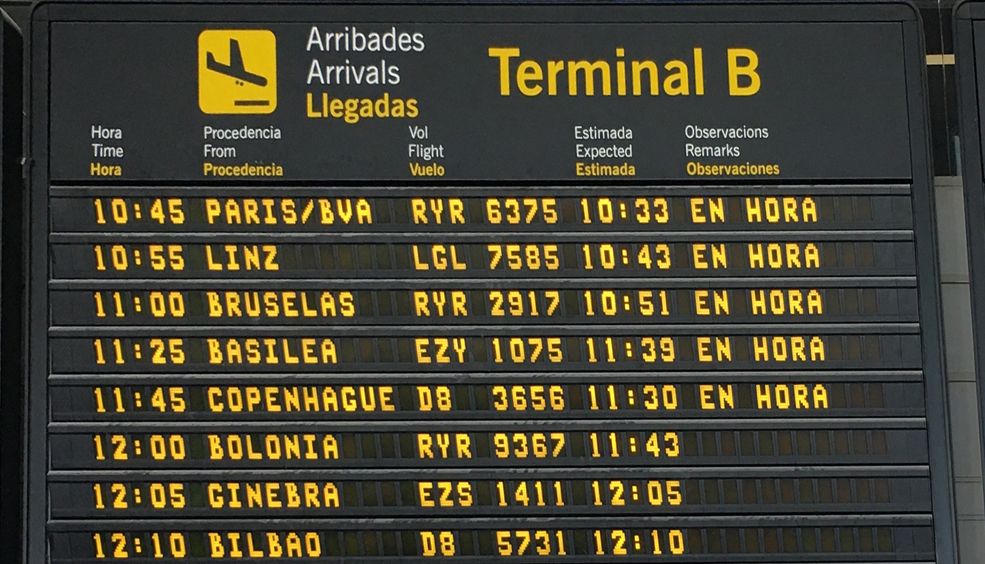
BCN, CDG, VIE, LGW.... All frequent flyers (and regular players of Trivial Pursuit) know what these three letters mean. They are IATA codes, in other words, the three letters that identify every single airport in the world.
more info