
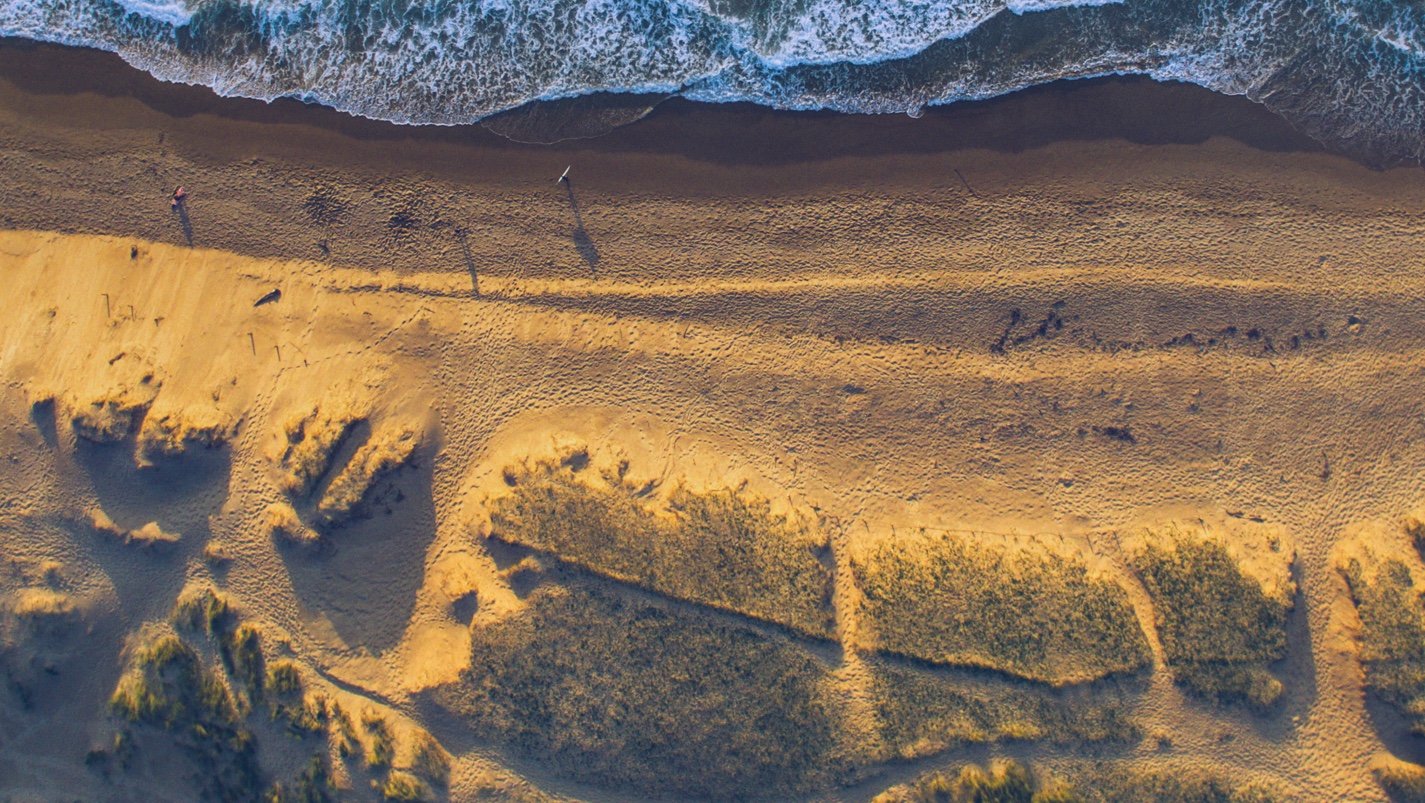

In Summer – A Beach in Brussels
The idea is not new. For some years now, these artificial urban beaches have popped up each summer in Berlin, Hamburg and under the bridges of the river Seine in Paris. You won’t have to cram the whole family into your car, or embark on a long, hot journey to feel the sand under your feet and freshen up in the water. In Brussels, this tropical paradise is known as Les Bains de Bruxelles and it lasts for five weeks on the Quai des Péniches, along the Brussels Canal. It opens from 11 a.m. to 10 p.m. on Tuesdays, Wednesdays, Thursdays and Sundays, and from 11 a.m. to 11 p.m. on Fridays and Saturdays.
True, there aren’t many waves, but some ingenuity has been applied to making the beach as attractive as possible; indeed, it draws an extremely diverse crowd of beach-goers. The 6,000 m² of sand are dotted with deck-chairs, palm trees and coconut palms, striped sunshades and beach bars serving vividly coloured cold beverages. The atmosphere is a family one during the day and sports activities include beach football, volleyball, boule and ping-pong, as well as games for young children. Pedalos and kayaks can be hired at reasonable prices on Sundays. You can also go for a ride along the canal on board the Bruxelles les Bains, which offers various tours – the short one takes 55 minutes; the longest one is a 2-hour cruise, and there is also a “cocktail cruise”, by night – while the harbour’s history and geography is expounded on by a guide.
This chill-out on the beach is accompanied by the Let It Beach festival, now in its third year. A variety of concerts liven up the evening on weekends, while on Fridays the music turns to folk, rock, pop and hip-hop. Jazz and world music take centre stage on Saturdays. The Sunday programmes target the younger set, with workshops, dances and, of course, more concerts. Night reverie is bolstered by free sessions of Croisetteke, every day from 6 p.m. on, in addition to theBoat Club,an exclusive floating club which hosts the liveliest parties in Brussels.
Not Without My Ice-cream!
When the thermometer seems to be driving endlessly upwards, another delicious way of keeping cool is to have an ice-cream. And, for those who can’t contemplate a day at the seaside without ice-cream, here are some of the best parlours in town:
Comus & Gasterea (Quai aux Briques, 86)
A place for trying the newest and most unusual flavours. It features some of the strangest ice-creams in the world, with such flavours as caviar, olive oil, Roquefort, lichi, wasabi aubergine and basil, home-made and free of additives or colouring agents. All you need is to be patient, as queues can sometimes build up outside its doors.
Capoue (Rue de Wand, 112)
Chez Capoue is one of the oldest ice-cream parlours in Brussels and, while at Comus & Gasterea you find the most unusual flavours, in Capoue they make the most daring combinations, notably bounty, blood orange and spiced bread. They are also have them sugar-free for diabetics, or lactose-free for those allergic to dairy.
Il Monello (Chaussée de Charleroi, 31 -33)
While Il Monello opened only recently, it has already made a name for itself in the city for its traditional pastries and homemade ice-creams. They also serve the latter atop a waffle for those seeking consistency (or calories).
Zizi (Rue de la Mutualité, 57A)
Zizi, a veritable institution in Brussels, is the city’s best-known ice-cream parlour. In the sixty years they have been open, they have never altered their manufacturing process. The flavours are natural and free of colouring agents.
Brussels Rules!
Brussels is a refreshing destination this summer, but not only because of its urban beach. Throughout the summer, every Friday from 5 p.m. to 11.30 p.m., the Apéros Urbains or animated afterworks are held in some of the most attractive spots in the city. Also featured is the Midis Minimes classical music festival, with daily concerts lasting 35 minutes from 12.15 p.m. (until 28 August), held in the Church of Saint-Jean et Etienne aux Minimes and in the Conservatorio Real.
Come and experience it for yourself. Come on! Pick up your towel and check out the flights to… Brussels!
Text by Scanner FM
Images by Eric Danhier
more info
The ocher jewel of the Mediterranean
Despite being a small redoubt in the middle of the Mediterranean consisting of the inhabited islands of Malta, Gozo and Comino and three uninhabited, Cominotto, Filfla and St. Paul, the Maltese archipelago concentrates a great historical and cultural wealth. Some of their spots are part of the World’s Heritage Site, such as the city of Valletta, the Hypogeum of Hal Saflieni (the only underground temple in the world) and the Megalithic Temples.
One of its universal symbol is the Cross of Malta, that with its eight points represents the eight different nationalities of the Malta’s Order of the Knights and its eight principles to be respected: spirituality, simplicity, humility, compassion, justice, mercy, sincerity and endurance.
Valletta, its capital, is named in honor of Jean Parísto of Vallette, Grand Master of the Order of the Knights of St. John, who managed the reconstruction after the Turks expulsion in 1565.
If there is one Malta can boast about, it is the large number of churches built mainly in the XVII and XVII centuries. There are more than 300 but the most outstanding one is St. John of Valetta. It houses in its interior one of Caravaggio’s masterpieces, The Beheading of Saint John.
An island that is a real movie set. Here have been shot great epic movies like Troy, Ágora or Gladiator. Amenábar chose Fort Ricasoli in Kalkara to represent Ágora’s Alejandria, which also served as a stage set for Gladiator’s Roman Colosseum. Another highlight for the filming of this movie is the Grand Harbour of Velletta, Mediterranean's largest natural harbor.
Next to Spinola Bay in St Julians and in the port of Marsaxlokk there are the best places to enjoy one of Malta’s most characteristic images: the harbor with its traditional colorful boats, the djhajsa and the luzzu, flooding its banks. Traditionally painted in bright colors you will notice in that in the sides they have the ornaments of Osiris Eye, a charm to bring good luck.
Among the straight streets of the old town, Republic Street clearly stands out, it is the main shopping street and thoroughfare in the city, named to commemorate Malta's independence from Britain in 1964. It was Exactly on the 21st of September, a day celebrated with great festivities.
The street combines great palaces like the Gran Maestre, Casa Rocca Piccola and the Museum of Archaeology. Its ancient ocher buildings also stand out at night when lit to bring out its beauty.
You can also enjoy their outdoor markets, like the one set up every day on Merchants Street. And on Sunday, the big market at the gates of the city of Saint James' Ditch. In the fishing village of Marsaxlokk they have one of the most traditional ones, where you discover the authentic taste of Malta. They are the best places to get an idea of the Maltese way of life.
Some of the tours you can do in Malta
Delve into the underground cave of Ghar Dalam
The underground cave of Ghar Dalam (the dark cave) was the home, 6,000 years ago, of the Neolithic inhabitants. Now you can see the remainings of some prehistoric animal ossuaries like hippos, deers and elephants showing that the island was sometime part of the continent.
Dingli Cliffs
Found on the west coast of the island. Its impressive cliffs are ideal for lovers of mountain climbing and rappelling, especially in Ghar Lapsi under the Dingli cliffs.
Mdina
About 10 miles from Veletta there is the town known as "The city of Silence" with medieval narrow streets that draw a maze. It was once the capital of the country and still retainins many spectacular churches and palaces in which to read the history of the island.
Looking for peace: Gozo and Camino
The other two islands of the Maltese archipelago are the ideal destination to enjoy peaceful days in a natural setting. Islands in the hills and valleys where you can walk through their rural trails and creeks leading into the sea. Its crystal clear waters are ideal for water sports such as windsurfing and diving.
In Comino, a small island that actually lives up to its name, you will find exotic beaches, including the famous Blue Lagoon.
Makes you want to go, right? Do it! Check out our prices here!
more info
Take up Slow Tourism in the Province of Ferrara
Slow Tourism – What’s That?
Who has not felt stressed at the end of some trip? We tend to arrive at our destination and set about “logging” all the monuments and places of interest marked in our guidebook. This goes on, day after day, until, when we return home, we suddenly realise, exhausted, that our mind is cluttered with haphazard recollections of everything we have seen and done.
There is an alternative to conventional sightseeing known as slow tourism, an offshoot of a cultural trend called the Slow Movement, which aims to overturn all that. In essence, it involves taking our time when visiting a particular city or region, enabling us to imbibe more deeply the spaces we encounter, our contact with people and our forays into local culture. This is clearly a more sustainable form of tourism, closely related to nature activities, although not limited to them.
In northern Italy, in the region of Emilia-Romagna, the province of Ferrara offers two major spots where we can engage in slow tourism – its capital, Ferrara, known as one of Italy’s most tranquil destinations, and the Po river delta, with an endless variety of nature activities. If to this we add the calm temperament of its inhabitants and their rich gastronomy, we have no excuse not to take our time getting to know that province.
The Valli di Comacchio, a Stroll through Nature
One of the mainstays of the economy in the province of Ferrara is thePo river delta,a highly fertile land for cultivating fruit and grain, and an ideal area for fishing. It also stands out for its wealth of flora and fauna, leading it to be listed as a World Heritage Site by UNESCO in 1999.
Lying south of the Po Delta Regional Parkbetween Comacchio and the Reno river lies the Valli di Comacchio, an area well worth visiting on account of its uniquely beautiful landscape. This is a marsh area stretching for some 11,000 hectares of typically flat land where the waterbody alternates between brackish and seawater. The best way of negotiating the area is by bicycle, for which several routes have been designed for fairly comfortable cycling. Outings by boat, on horseback and walking tours are also organised. One of the major activities here is bird-watching, the main birding species including mallards, flamingos, herons and cormorants.
In the middle of this natural space lies the town of Comacchio which is picturesquely built on 13 islands interconnected by a series of bridges and canals. That accounts for it being mentioned in several guidebooks as a “little Venice”. Fishing is one of the main activities in the area, so don’t forget to try out their foremost culinary speciality, anguilla marinata (marinated eel), which is still prepared according to a traditional recipe. If you’re curious to learn more about how this delicacy is made, we can recommend a visit to the Manifattura dei Marinati.
Ferrara – Serenity, Renaissance and Bicycles Galore
Ferrara is perfect for those interested in a city which combines serenity and a generous measure of art. Medieval in origin and ruled in the past by the Este family, this city is characterised by an urban-planning project designed by the architect, Biagio Rossetti, who crafted it into one of Italy’s prime Renaissance destinations. A must-see is the Castello Estense with its moat, in the city centre, in addition to the Duomo, the Via delle Volte and the old Jewish ghetto. Prominent among its magnificent Renaissance palaces, most of which have been turned into museums, are the Palazzo del Comune, the Palazzo della Ragione and the Palazzo dei Diamanti with its distinctive diamond-shaped blocks.
A feature of Ferrara which strikes one immediately is the large number of bicycles plying its streets, reminiscent of Amsterdam. We recommend hiring a bicycle and going on a delightful tour of the city walls – you won’t be disappointed.
When it comes to culinary delicacies, you must try the pasticcio di maccheroni (baked macaroni with Parmesan cheese), salama da sugo (roast pork sausage, usually accompanied by mashed potato) and Ferrara bread, with its distinctive flavour and unusual, four-crusted shape.
Perk up and explore this beautiful region – check out our flights!
Texts ISABELYLUIS Comunicación
Photos Photo Archive of the Province of Ferrara
more info
Good Morning Ibiza and Good Night!
When it comes to lifestyle, Ibiza is unquestionably one of the world’s hotspots. All celebrities worth their salt make a point of visiting it in summer, but, what can you expect to find there other than between May and October? Los Viajes de ISABELYLUIS dropped in on the Balearic pearl to see what brews out of season. We were amazed to discover that it is an ideal getaway for switching off. Ibiza offers the very best of slow tourism – idyllic scenery, trekking routes, fairy-tale villages and the constant friendliness of its inhabitants.
Good Morning, Ibiza!
If you have a penchant for welcoming the dawning day in the finest setting, we recommend you rise early – or stay up – and head for Cala s’Argamassa, very near Santa Eulària. This is definitely the key spot for for experiencing the Ibizan “awakening”.
Now that you’re on track, we suggest you go to the north-east, the most protected and sparsely inhabited part of the island. It is also the wildest, most rugged area and is a must for photography, if you’re looking to capture the essence of the genuine Ibiza. You will come across forests of pine and inaccessible coves. A stroll through the minute – and very quaint – villages would be in order, notably Santa Agnès. On the edge of the village you take the Camí Plade Corona which leads to a fascinating field of almond trees – preferably, in February, when the almond blossom is spectacular.
If you happen to be on the island on a Sunday, a good option for day-tripping is to visit the Sant Joan de Labritja street market with its craft wares. The hippy atmosphere so redolent a few decades ago stills lingers here. The stalls are stocked with goods for all tastes, from Moroccan leather to designer fabrics. We recommend taking a seat in the Restaurante San Juan, as it affords views over all the goings-on in this picturesque street market, which opens from 10 a.m. to 4 p.m. The view also takes in the charming Church of San Juan, built in 1770.
From here, you can drive to Portinatx, the island’s northernmost point. On arrival, make sure you have a walk around Punta Galera, Punta des Moscarter, Punta d’en Gat and Cala d’en Serra. Then, the best thing is to return in an eastward direction, which takes you through such charming villages as Sant Miquel de Balansat and Sant Mateu d’Albarca. Their churches are the epitome of Ibizan religious architecture, which harmonises with the traditional stone and lime constructions. The churches are inviting, yet characteristically sober.
Good Night, Ibiza!
One of the most magical moments is dusk. There are sites for all tastes, but the best spot on the island – or, at least, the favourite among the islanders – is Cala d’Hort, a mere 11 km from Sant Josep de sa Talaia. From that point on the coast you can make out the beautiful and enigmatic islets of Es Vedrà, Es Vedranell and Sa Galera, which are said to give off a special energy – UFO sightings have been reported here. This V-shaped inlet is flanked by an open, uneven, rugged coastline with tall surrounding cliffs carpeted with pine and scrub. The beach has medium-grain white sand and mild breezes. The slope is gentle and the waters are crystal-clear, with a sandy seabed. There are three excellent seafood restaurants in the area. Cala d’HortRestaurant and Restaurante El Carmen are on the beach itself, while Es Boldado is accessed via the road running from Sant Josep. Don’t forget to bring along your camera or smartphone to capture the sunset. Here you will find that elusive desktop wallpaper that looks so good on your computer screen.
The other splendid sunset is to be had in Cala Comte. It provides a moving spectacle. People start massing silently along the coast at the prescribed time, generating a sort of ceremonial trance-like atmosphere in which everyone concurs in contemplation and introspection. The picture will undoubtedly leave an indelible mark in your memory.
Once the sun has gone down, it’s time to return to the built-up area for dinner. And, to round off the day, one of the best places to spend the night is the Hotel Simbad, which was completely refurbished in 2007. It’s a 10 minutes’ drive from Ibiza’s historic centre. One of its boons is the panoramic views of the sea and the castle to be had from its rooms. In high season you can also use the swimming pool adjoining the beach, but all year around they have a solarium and wellness centre which includes a heated indoor pool with a waterfall, a jacuzzi, gym, sauna and massage showers.
Ready to discover “the other” Ibiza? Check out our flights here.
Text by Los Viajes de ISABELYLUIS
Images by Ibiza Travel and Los Viajes de ISABELYLUIS
more info