
Tel Aviv An Oasis of the Bauhaus
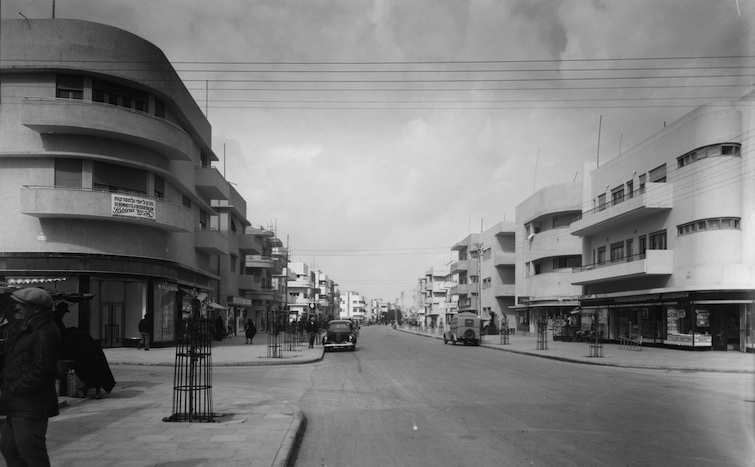
The Bauhaus is to Tel Aviv what Art Deco is to Miami or Modernism is to Barcelona, an unmistakeable identity trait which is the pride and joy of the city’s inhabitants. We came across more than 1,000 buildings in the length and breadth of the city, which stretches for 50 square kilometres.
Bauhaus Comes To Tel Aviv
The relationship between Tel Aviv and the Bauhaus goes back to the 1930s when, coinciding with the rise of the Nazi party, many Jewish architects decided to leave their homeland and try their luck elsewhere. At that time, the future metropolis was a young city with an urge to expand and to tap its full potential. The so-called White City – as the area housing these buildings is known – was built between the early 1930s and 1948 to an urban layout designed by Sir Patrick Geddes, based on the principles of modern organic urbanism. The likes of Walter Gropius, the founder of the Bauhaus in Weimar, and of Arieh Sharon, Shlomo Bernstein and Shmuel Mestechkin, arrived in Tel Aviv and drew up an elaborate, ambitious urban plan which enabled the directives of this style to be adapted to the arid surroundings of the site and to its Mediterranean context. Thus, the light, fresh air of this architecture consorted to perfection with the thirst for renewal and creativity that characterised what would become the new State of Israel as of 1948.
Preservation – A New Challenge
The buildings were designed in light colours – generally white – leaving open-air pillars for the wind to blow unfettered through the lower part of the buildings, while recessed windows were fitted to check the passage of heat. The Bauhaus of Tel Aviv is also characterised by its straight lines, its symmetry and a minimalist style which even today tends to amaze visitors on account of its simplicity and overall character. The fact is that, faced with a new cultural context, those architects designed an exceptional set of buildings which became highly representative of the modern architecture movement.
Despite the large number of such buildings scattered about the city, their state of preservation is somewhat precarious. In fact, over 4,000 of these buildings were originally erected, so many of them clearly did not survive. Hence, concerted endeavours have been under way in recent years to restore over 1,000 extant constructions to their original state. It is a slow, arduous task, as most of them are private property and have not been touched since their completion some 70 or 80 years ago.
The Best Examples In the City
Given the large number of surviving buildings, the best thing is to plan an itinerary before embarking on a search of Bauhaus buildings in the city. Some of the most prominent examples are on the Rothschild Boulevard, and on Bialik and Dizengoff Street, but you are advised to first visit the Bauhaus Center to get the relevant information. They have books and maps on the subject and you can find out about the free tour organised by the City Hall on Saturdays called the Tel Aviv-Bauhaus Walking Tour.
To round off your visit, be sure to visit the Bauhaus Museum on Bialik Street which is useful for gaining insight on the impact which the Bauhaus of Tel Aviv has had on the rest of the world.
Text by Aleix Palau for Los Viajes de ISABELYLUIS
more info
The Picturesque Villages of Lake Garda
Lake Garda, situated in the north of Italy between Lombardy and Veneto, is the perfect destination for those seeking a balance between nature, historical heritage and gastronomy. It is also the ideal spot for trekking, mountaineering, cycling, sailing and windsurfing. Here, then, is our selection of the prettiest villages in the area. See which ones catch your fancy.
Desenzano del Garda – Gateway to the Lake
Desenzano del Garda is the largest town around Lake Garda. Located on the south side, it is the prime entry point to the lake. The old town is a delight to stroll through and the atmosphere there is amazing, particularly at dusk. A must-see landmark is the Cathedral of St Mary Magdalene, where you can contemplate Tiepolo’s The Last Supper, and the Villa Romana, located on the Via Crocifisso, which features some standout mosaics.
Sirmione – the Pretty Girl
Situated on a narrow peninsula on the south side of Garda, Sirmione is undoubtedly the prettiest town in the area and, consequently, the most touristy. As soon as you catch sight of its old town and its fantastic medieval castle – with a drawbridge included – you will realise why it is so popular and succumb to its charms. Noteworthy, too, are the ruins of an ancient Roman villa known as Grotte di Catullo (Grottoes of Catullus). Despite having nothing to do with a cave, or having ever hosted Catullus in its grounds, it features some excellent, well-preserved frescoes and the views from its olive grove are stunning.
Malcesine – the Shore Lined with Olive Groves
This small town, which is famous for its olive oil, was immortalised by Gustav Klimt en 1913. A prominent landmark is medieval Scaligero Castle which towers over the surrounding houses and has a room dedicated to Goethe. The latter devoted a few lines to Malcesine in his Journey to Italy.It is well worth taking the cableway which runs up to a height of 1760 metres where you can get magnificent views over the lake.
Gardone Riviera – An Elegant Town On the Lake
Its 19th-century villas in Art Deco style and its spectacular gardens make this the most elegant town on Lake Garda. The most prominent feature is the Vittoriale degli Italiani, an unusual and sumptuous estate made up of several buildings, a theatre, gardens and waterways, the work of the poet, Gabriele D’Annunzio and the architect, Giancarlo Maroni. The other must-visit spot is the André Heller Foundation Botanical Gardens which has around 500 plant species.
Riva del Garda – For the Sporting Crowd
This town, set on the northern edge of the lake, against a backdrop of mountains, is ideal for sports enthusiasts. It is the starting point for hikes and cycle tours to Mt Rocchetta and also hosts such watersports as sailing and windsurfing.
Book your Vueling to Verona, which lies just 45 kilometres from Lake Garda, and enjoy yourself sightseeing its shores.
Text by Los Viajes de ISABELYLUIS
Images by Elin B, Marcos Dione, Edoardo Costa, Edwin van Buuringen, Tony Hisgett, Ross Elliott
more info
5 chocolate shops in Brussels
By Laia Zieger from Gastronomistas
If you've visited to Brussels, you're sure to have noticed that chocolate is a serious matter here. It is one of the city's emblems that has also earned it world fame in the dessert sector. But, with so many choices, where should you go to try the best chocolate in Brussels? Around the Place du Grand Sablon and its surrounding areas is where there is the greatest concentration of really high-standard chocolate shops. They are all rivals in the exclusivity and quality of their raw materials, in speciality and creativity. One of the most visible signs of chocolate power in Brussels is that the establishments that make this confectionery close late at night and open every day of the year. There's no rest for the sweet-toothed.
• Patrick Roger (Place du Grand Sablon, 43). Ultra-luxurious, this shop is a real gallery of art dedicated to chocolate. The chocolate artist and flavour sculptor - as Roger introduces himself - expresses all of his mastery in impressive and enormous cocoa figures that are displayed at the premises and are only for aesthetic purposes. But let's not forget what's important: they are distinguished by delicious and very fine chocolates, that seem simple but hide extraordinary complexity: they combine up to 14 different products to obtain a unique flavour.
A special mention for the little plain chocolate squares with lime and basil ganache. Speechless.
•Wittamer(Place du Grand Sablon, 6, 12, 13). Four generations of the same family have devoted themselves to making delicious traditional chocolates and cakes, but also to innovating and adapting to new trends. They make their almost 100 different chocolates (some with seasonal ingredients or inspired by current events) with cocoa ‘grands crus’. El Pavé de Bruxelles (plain chocolate filled with Brazilian-style praline and caramel), registered as the firm's own recipe, is their most famous chocolate. But the most daring idea, without a doubt, is their bar covered in fried grasshoppers sprinkled with gold...
•Maison Pierre Marcolini. (Rue des Minimes, 1). Rather than a chocolate shop, it is a cocoa jeweller's shop. The hundreds of different chocolates they make are on display behind glass. To make his products, the Master Marcolini brings the most delicious raw materials from the five continents.
There are also limited editions for celebrating special events and current affairs.
•Neuhaus.(Rue Lebeau 79). The history of this brand is very curious. Jean Neuhaus settles in Brussels in 1857 and, with his brother, opens a chemist on the prestigious Galerie de la Reine. To disguise the taste of the medicines, he decides to cover them with a layer of chocolate. It's not known for sure how, but one day he substitutes the drugs with fresh cream and so creates the first filled chocolate, which he calls praline, and which is one century old this year. It is an immediate success and this recipe spreads as a chocolate classic in cake shops all over the world.
• A little further from the Place du Grand Sablon, we find Zaabär (Chaussée de Charleroi, 125), which defines itself as a chocolate and spice shop. In fact, its name is inspired by the Arabic word bazaar - a market where you can find numerous condiments. The speciality of this firm are chocolate bars flavoured with spices (the plain chocolate ones with cinnamon, Guérande salt or Szechuan pepper are incredible). The point that differentiates Zaabär is that it organises chocolate-making workshops (there are ones for learning to make truffles, cakes…). Ideal for groups and families visiting Brussels, or simply foodies searching for new experiences.
Makes you want to go, right? Do it! Check out our prices here!
more info
The Infiorata di Genzano – a Street Become Artwork
Genzano is a charming town built on one of Rome’s hills. Every year it hosts the Infiorata di Genzano, when its main street, the Via Italo Belardi, is carpeted by 2,000 square metres of enormous tapestries adorned with flowers. This artwork uses up nearly 500,000 petals, flowers and seeds meticulously placed to form intricate pictures inspired by religious themes. It is a collaborative venture involving many of Genzano’s inhabitants. Just as painters have their palette, for the Infiorata, different types of flowers are selected according to each colour – carnations are used for reds, broom for yellows.
For the three-day duration of the festival, the town’s shopkeepers set up their marquees from where they sell the region’s typical food products, such as olive oil or pane casereccio, a famous crunchy bread and one of the most emblematic of local gastronomic products. TheInfiorataremains on the streets until the so-called Spallamento, the moment when the music bands and the town’s children walk over the infiorata, until the whole carpet is trampled underfoot.
The Origin of the Flower Carpets
These colourful flower carpets are laid down in many other towns around the world. Notable examples are the Temps de Flors in Girona and the Alfombras de Sal in Lanzarote. Their origins go back to theCorpus Christicelebrations of the 13th century, when flowers were thrown during the Holy Week procession in Rome, a tradition that then spread to many other Catholic countries. Other towns in Italy also have their own infiorata, but the one in Genzano is the oldest and most famous, dating back to 1778.
The Historical Towns of Castelli Romani
Genzano is one of thirteen historical towns that make up the so-called Castelli Romani (Roman castles), which roughly correspond to the area of Colli Albani (Albanian hills) south-east of Rome. For centuries it has been a favourite spot for well-heeled Romans seeking a more temperate climate, to escape from the often suffocating heat of Rome and also to get away from the city bustle and dense traffic. The towns in the Castelli Romani Regional Park stand out for their medieval and Renaissance buildings and for their excellent wine, the so-called white Frascati. You can taste this wine, accompanied by olives, cheese andporchetta– a roast pork dish with herbs – at the local taverns or fraschette.
Genzano – A Charming Setting
Genzano, like other towns in the Castelli Romani, is set on the external slope of the Lake Nemicrater. Indeed, the volcanic origin of the soil is what endows the grapes used in the wine-making with their excellent quality. Its historic centre has a large number of historical and art vestiges for a town of its comparatively small size, including the Collegiata della Santissima Trinità (Collegiate Church of the Holy Trinity), the Annunziata, the Church of the Cappuccini, and the Sforza Cesarini and Villa degli Antonini palaces. Lake Nemi’s claim to fame is that two of the largest and most luxurious vessels from antiquity were found in the crater – both had belonged to Caligula. For 2,000 years they rested at the bottom of the lake before eventually being salvaged in perfect condition, on account of the mud found caked around them. You will delight in the natural surroundings of the Genzano area, which is ideal for cycling. A bike tour will take you along scenic routes featuring lakes, craters and forests.
If you don’t want to miss this year’s Infiorata di Genzano, prepare your trip to this picturesque Italian town for 13, 14 and 15 June 2015. You will enjoy a spectacular event that draws thousands of visitors. Check out our flights here.
Text by Scanner FM
Images by Fabio | Claudio Vaccaro | supermiagolator | supermiagolator | Malega | Deblu68 | Valerio_D
more info