
Shopping in Ventimiglia
By Michael Shuermann from Easy Hiker
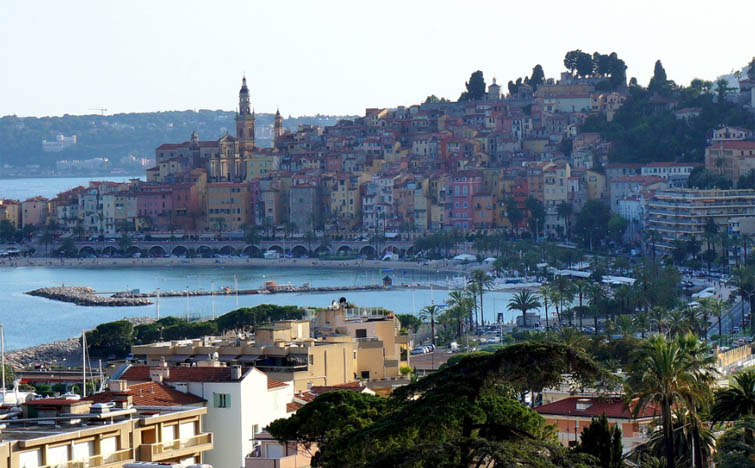
I still remember the first time we came into contact with Ventimiglia market – without even knowing that such a thing existed. We were boarding the local train from Nice to Menton, eastwards down the coast of the French Riviera in the direction of the Italian border. We were amazed to find it packed to the rafters at around 11 am on a Friday. From other trips on that line, we had been used to having a choice of seats on a weekday morning, but on that day, it seemed as though the entire population of the Cote d’Azur was on the move.
We did not find out until much later what was going on, but all these crowds were going to the Italian border town of Ventimiglia – the last stop on that line – for the popular weekly Friday street market.
The market mainly offers clothes, handbags and other leather goods – of mixed quality, it must be said, but occasionally, you can find well-crafted products at large discounts.
One of the market’s attractions apparently has something to do with the fact that – whisper it – the Italian police is less strict than its French counterpart in pursuing brand counterfeiters, so the French customs occasionally stop people on their way back from the market, asking them where they bought their shiny and new “Louis Vuitton handbag”. Be forwarned.
The market also features a section where farmers offer domestic food products. You can buy specialties from all over Italy here – Calabrian sausages, Parmesan cheese, olive oil – but also local produce such as sun-dried tomatoes and home-made pesto sauce, one of the things for which the province of Liguria (which includes Ventimiglia) is famous.
Have a coffee in one of the many charming little coffee houses around the 1930s municipio, the City Hall. You are only 15 km away from the French border town of Menton, but you will already feel a marked difference in the general liveliness (and noise levels) of the street life.
On market days, there is also a particularly large number of ambulant traders around who are walking from cafe to cafe peddling key chains that glow in the dark, small novelty household items and the like.
We have gone shopping many times at Ventimiglia market, and often, what we have bought from the peddlers turned out to be our most unforgettable purchases. What would our lives have been without the cicada fridge magnet that starts to sing when somebody approaches it?
You can reach Ventimiglia conveniently by local train (TER) from Nice. Trains leave frequently, generally every 30 minutes throughout the day. Don’t forget to bring a valid ID!
By Michael Shuermann from Easy Hiker
Why not take a trip to Nice? Have a look at our flights here!
more info

Between lakes and marshes
Nador, capital of the province of Rif, is a sprawling city with some Spanish flavor, as it is located only 15 kilometers south of the city of Melilla. Its main attractions are its natural beauty, scenic views and beaches.
Downtown Nador
In contrast with the traditional developments , the city of Nador has a layout of streets in a grid . Its main avenue Mohammed V Avenue , which crosses the city from east to west , from the City Hall to the Bou Areg lagoon by a pleasant palm trees and lampposts walk. . The other main spo is the Hassan II Avenue , which crosses from north to south to the bus station.
Here lies the largest tourist attractions in the city , though not particularly remarkable , it does have some attractions . We can recommend the Marhama restaurant, a large property with quick service and one of the best places to eat Moroccan specialties and international cuisine , prepared according to traditional recipes . It specializes in fish dishes such as sole , swordfish , monkfish , hake and red mullet that cooks prepare in front of customers, and recepies such as couscous , lamb kebabs and different tagines of rabbit , chicken or beef .
In the north of the city there is the souk Morakeb , one of the largest commercial complexes in which you can find a little of everything. To your right there is the Kasearia souk or gold souk, famous for selling gold, fabrics and garments.
Sebkha of Bou Areg
Nador’s rich natural environment is one of its main attractions. At the foot of the city of Nador there is the Mar Chica or Sebka of Bou Areg , a stunning lagoon in which fresh and salt water mix. Ponds, marshes and dunes are a valuable ecological environment that shelter many species of seabirds and waterfowl as pink flamingos , the hoopoes or plovers .
Kariat Arkmane
About 23 kilometers from Nador there is the village of Kariat Arkmane . Surrounded by Bou Areg’s lagoon , its waters attract various species of birds such as flamingos and terns , which can be seen walking along the beach easily .
The Gorges Zegzel
About 70 kilometers through the plain of the road Moulouya Oujda surrounding the massif of Beni- Snassen , there is the turnoff to the Gorges of Zegzel . A perfect area for excursions for its spectacular scenery .
Image: Kokopelado
Why not take a trip to Nador? Have a look at our flights here!
more info

Beer Garden Season
Beer is the most popular drink in the gastronomy of Munich and to sample it, you can take advantage of the dozens of Biergärten or beer gardensthat can be found all over the city, where, sharing huge tables in the sunshine, you can enjoy the cheerful Munich lifestyle, try out some Bavarian delicacies or even bring along your own food, but never the drinks!
The Munich biergarten season takes place between Spring and Autumn when the sunshine allows you to enjoy these traditional gardens as well as the many outdoor terraces that together offer in the region of 180,000 al fresco seats
Among the biggest venues are the 8,000 seater Hirschgarten, or 5,000 places at the Augustiner in Arnulf Street and the Paulaner in Nockherberg with space for 4,000.
Other notable meeting places include the biergarten in Viktualienmarkt Square, the one next to the Chinese Tower in the English Garden or the Waldwirtschaft, where jazz music livens up the atmosphere.
Augustiner-Keller
This biergarten overflows with tradition. With more than 5,000 seats under the shade of 100 magnificent chestnut trees, it guarantees the most authentic experience of them all. 45 of these trees are protected species and are duly numbered. The Augustiner-Keller itself appears as a beer store on a map of the City of Munich dated 1812. The cellar belongs to the oldest brewery in the city and is a perfect example of traditional Munich conviviality and its legendary hospitality.
www.augustinerkeller.de
Arnulfstraße 52 80335 Munich
Biergarten in the Viktualienmarkt Square
You can buy anything you feel like for your tea and eat it straightaway washed down with one of Munich’s famous brands of beer that take turns supplying this beer garden situated in the very heart of the Bavarian capital.
www.biergarten-viktualienmarkt.de
Viktualienmarkt 80331 Munich
Biergarten at the Chinese Tower
After a little sunbathing or having enjoyed a stroll around the English Garden, your visit to the park can be rounded off next to the Chinese Tower with “tea” accompanied by a fine beer in the shade of the chestnut trees. On Sundays the atmosphere is enhanced with live music from a wind band.
www.chinaturm.de
Englischer Garten 80538 Munich
Biergarten at the Staatliches Hofbräuhaus
The congenial Hofbräuhaus beer garden is a surprise, away from the hustle and bustle of the big city, where you can enjoy the world famous beer and culinary delights of Munich in a truly welcoming environment.
www.hofbraeuhaus.de
Platzl 9 80331 Munich
Why not take a trip to Munich? Have a look at our flights here!
more infoBerlin, a prismatic city
By Monia Savioli from ilTurista.info
Berlin: Young, lively, trendy but cheap, organized, linked to an important past which doesn’t forget and doesn’t want to. You can’t define the city of Berlin just listing a limited number of adjectives and characteristics. That would restrict its beauty and what the city can offer to people.
Vueling launched the route Florence-Berlin on March, the 22nd increasing its new offer from Florence with furthers routes to London Heathrow, Copenhagen and Hamburg providing 160.000 new seats in addition to the already available flights to Barcelona, Paris and Madrid. There is an efficient bus shuttle service that connects Florence train station to the airport. From the train station, you can reach the airport in 20 minutes and by an about 90 minutes flight you arrive at the Tegel International Airport of Berlin.
The only clashing point is that the German airport is not connected directly to the city by underground, although the net is constantly increasing. It’s possible to reach the nearest station by taking a bus from the airport. You can ask for more information about the bus within the airport, where people speak English if you don’t know German (bus and taxi drivers often speak only German). If you want, you can also take a taxi since rates are cheaper than the Italian’s ones. The bus that brings you to the city is the 128 and leads to the “Kurt-Shumacher-Platz” underground station and the course lasts about 15 minutes. Once arrived to the underground station, you can use the same ticket to reach Friedfrichstrasse, the core of Berlin and the shopping road par excellence. There, you can take a room at the Melia Hotel, just close to Spree river and to the Metropol Theatre. Friedrichstrasse is a strategic point to chance upon the famous “Unter den Linden” boulevard, going into the core of the city visiting the main Berlin places that you should see in a 2-days-trip.
If you prefer walking, you can also visit the city with your own feet or you just ride the several bikes for rent. There are also buses for scenic tour working up to 6 p.m. that let you get on and off to visit the main important places.
One of these places, is “Charlie”, at the Friedrichstrasse. It originally was a checkpoint between the Mitte and Kreuzber districts. Mitte belonged to the East Berlin, run by Soviets in the past and Kreuzber to the West side of Berlin, run by Americans. The name of the place, Charlie, is pronounced as the third letter of NATO phonetic alphabet after “Alfa” and “Bravo”. Nowadays Charlie checkpoint is a bar where you can taste delicious drinks or drinking beer sitting on beach chairs with you feet on the sand. The headquarter of the old Gestapo is on the Niederkirchnerstrasse where you can find few empty tiled buildings. It’s situated next to a portion of the Berlin’s wall that is ruined and constantly reduced because visitors often steal pieces of wall as souvenir. In that place now there is a permanent photography exhibition called“Topography of terror” about Nazism. So it’s evident how the old and the young Berlin are living together, to bearing in mind a past that no one can’t forget, fixing it through feelings felt due to the almost holy silence you can find in those places as a sign of respect.
These are the same feelings and sensations you can feel within the Holocaust Memoirs, in the Cora-Berliner Strasse, where there are 2.711 anonymous grey stones with an irregular shape that are arranged within a field characterized by several bumps that gives you the feeling of a dark choking and light-living feeling at the same time.
The East Side Gallery, an almost 2 kilometres of the Berlin’s Wall on the Mulenstrasse (ex East Berlin) is now the longest open-air art gallery in the world and show you several visions about the years of the split of Berlin. The murals realized by international artists offer alternative points of view by illustrating characters and symbolisms of that period as the Trabant, the famous old Berlin car, drawn as it would break down the wall.
For the aficionados, it’s also possible to rent a “Trabi” to drive around the city or take one of the odd vehicles situated along the Brandenburg Gate, the symbol of a reunified Germany and the access gate to the Tiergarten. This is a former shooting ground of the royal palace where you can find the Victory Column and the famous zoo.
There are also several nice flea markets along the boulevards where you can buy an endless quantity of stuff during the weekend, from jewelleries to art masterpieces or, for instance, mother-of-pearl-made spoon for enjoy your caviar. Is not all. Berlin is also the city of museums: from the biggest Hebraic museum in the world to the Egyptian museum, the National Art Gallery and several other ones.
Berlin is also the city of the big palaces, churches’ ruins as the Kaiser Wilhelm Gedachtniskirche, whose ruins keep the recollection of the Second World War bombing alive. At least, but not the last, Berlin is the city of the shopping centre as the Come KaDeWe, “Kaufhaus des Westens”: the most famous shopping mall in Germany and the biggest one in Europe with 60,000 cubic meters that are branched in 7 sector floors for products except the last one where you can eat at the self service restaurant. Other way, downstairs you can eat in several buffets as the one managed by one of the most famous international chef, Paul Bocuse. There is also a Lafayette store section. But the real fun, actually, is getting lost among the little shops and the street markets. Berlin offers also a lot of night bars, international top level restaurants, pubs, night clubs and alternative locals assuring fun to every kind of target of people.
Thrill-seeking people can even try bungee jumping from the top of the Hotels in Alexander Platz. In order to finish your trip, you can have a long and relaxing boat ride across the Spree river from where having a wide vision of the German capital to realize that Berlin is not just a touristic destination but a real city with its beautiful places and also its difficult realities as homeless people sleeping in sleeping bags along the streets of this great but cold city.
Por Monia Savioli de ilTurista.info
Why not take a trip to Berlin? Have a look at our flights here!
more info