

A Good Shot of Art Nouveau in Brussels
Brussels may rightly pride itself on having a large number of Art Nouveau buildings, a veritable pole of attraction for anyone visiting the city. Indeed, the Belgian capital was one of the focal points where this art movement emerged in the late-19th- and early-20th century. Art Nouveau ended up permeating all artistic disciplines, from architecture to sculpture, painting, furniture design, jewellery and graphic design, among others.
Modernism, which came to be known as Art Nouveau in France and Belgium, took its first few steps in Brussels in 1893 with the construction of the Tassel House, located at 6 Rue Paul-Emile Janson, designed by the architect Victor Horta. The idea was to then create a new style which involved breaking with the past by leaving behind the historicism which prevailed in architecture at the time and usher in another style which more accurately reflected the modern era. This break led to the rise of two trends in the city – the floral style, with forms inspired by nature, of which Victor Horta was the most prominent exponent, and the geometric, as championed mainly by the architect and designer, Paul Hankar.
The advent of this movement coincided with a time of growth in the city, when such districts as Schaerbeek, Etterbeek, Ixelles and Saint-Gilles were in the throes of urban renewal, so that many of the houses that went up in those areas were imbued with the new style. Some 500 buildings from that period have survived to the present.
The Major Landmarks
Among the must-see gems of Art Nouveau in Brussels are, in the first instance, the four buildings known collectively as the“Major Town Houses of Victor Horta in Brussels”,all of which were designated World Heritage Sites by UNESCO. They are as follows:
Tassel House. As mentioned above, it is regarded as the first manifestation of Art Nouveau in Brussels, as well as one of the first in the world to open up a new direction in contemporary architecture.
Hôtel Solvay. Located at 224 Avenue Louise, it is possibly one of the standout buildings of Belgian architecture. Its facade reveals the presence of glass, iron and natural stone, Victor Horta’s favourite materials.
Hôtel van Eetvelde. Edmond van Eetvelde, administrator of the Congo Free State, commissioned Victor Horta to design this town house with a view to providing a modern space for entertaining his visitors. Located at 4 Avenue Palmerston, it is striking for the innovative distribution of its interior spaces and for the stained-glass and mosaic ornamentation.
Maison & Atelier Horta. Converted into what is now the Horta Museum, this was the home of Victor Horta, built from 1898 to 1901. It comprises two independent buildings in that each has its own style, but they were conceptualised as a unified whole and are interconnected.
Another building that should feature on your itinerary through the Art Nouveau landmarks of Brussels is the Comics Art Museum. Built in 1906, apart from from being a compulsory place of pilgrimage for devotees of the ninth art, it is a magnificent example of Art Nouveau, the work of the iconic architect of the time in this city, Victor Horta.
Also make a point of visiting the Musical Instruments Museum, designed by the architect Paul Saintenoy and originally built as the Old England department store. And, wander down Rue Saint-Boniface, where you will come across five buildings designed by the architect Ernest Blérot at number 15, 17, 19, 20 and 22. And, lastly, we recommend you head for 71 Rue Defacqz, where you can admire the Paul Hankar House.
Now that you have some of the keys to discovering Art Nouveau in Brussels, book your Vueling here and get ready to enjoy it all.
Text by Los Viajes de ISABELYLUIS
Images by mertxe iturrioz, Arco Ardon , William Murphy , Steve Cadman, J. Miers
more info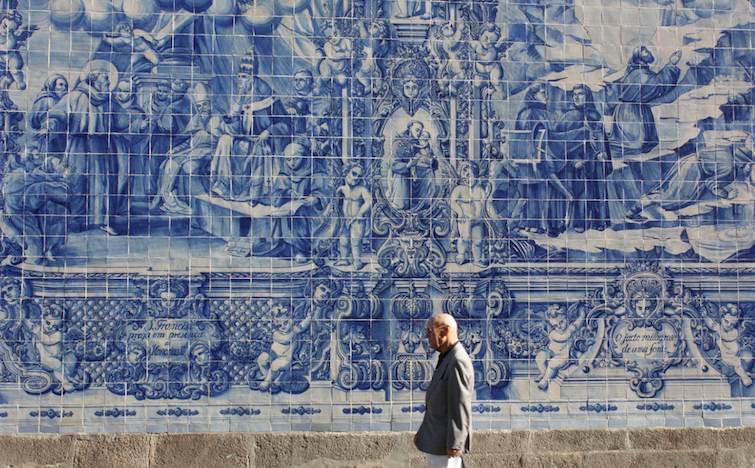
The Azulejo Tiles of Portugal
When you first visit Portugal, one of the things that invariably catches your eye is the pervasive presence of ceramics and wall tiles in ornamentation. Whether used as wall facings on the inside and outside of buildings – on churches, palaces or private homes, both in large cities and small villages – ceramic tiles are king in Portuguese decoration. Unlike the rest of Europe, where they are used more sparingly, in Portugal they seem to take over the walls. They feature in two major varieties – polychromed tiling and the signature blue-and-white combination, some of which are technically and aesthetically superb.
This cultural heritage of Moorish origin first took seed in Portugal in the 15th century, having entered the country via neighbouring Spain. It soon became the wall facing of choice among Portuguese royalty. The use and quality of ceramic tile decoration reached their zenith in the 18th century. Nowadays, azulejos are still very much in vogue and large workshops continue to operate.
While ceramics are in evidence throughout the country, following is a selection of the leading sites. They are well worth visiting – both for the exquisiteness of their ornamentation or owing to the presence of a large production centre.
Lisbon
As befits a capital, Lisbon is graced with numerous examples of azulejo tile facings, which even cover the walls of the city’s metro system. Among some unusual landmarks to be found in the city is the Quinta dos Azulejos, housed in the Colégio Manuel Bernardes on Paço do Lumiar street. The sheer decorative beauty of the scenes depicted on the walls in the garden is simply stunning.
However, the main reason for including Lisbon in this tour is the Museu Nacional do Azulejo, where visitors can learn all the ins and outs, production techniques and history of this quintessentially Portuguese element of architectural ornamentation. It is also a good point to start off the tour.
Aveiro
This small, beautiful city, also called the “Venice of Portugal” for its canals, which you can sail along in colourful boats known as moliceiros, is enchanting in itself. A coastal city famed for its fishing and salt production, it has a beautiful centre with outstanding examples of Modernist buildings. The authentic jewel of this city is the Railway Station, striking for its ceramic ornamentation and a fitting final flourish to any visit here. The polychromed azulejos feature depictions of railway scenes, as well as motifs from nature, culture and traditional activities. And, while you are in the city, be sure to see the beach with its bathing boxes painted in colourful stripes.
Ovar
This coastal city is worth visiting for its beaches, but it also boasts a large number of public buildings adorned with azulejos, most of which come from the factories at Vila Nova de Gaia and Aveiro. The plethora of tiled wall facings has earned Ovar the nickname of the “Azulejo Museum City”.
Válega
Just six kilometres from Ovar lies the village of Válega, where you should make a point of visiting the Church of Nossa Senhora do Amparo. Its walls are faced, both inside and out, with mostly polychromed tiles, except for the external side walls and back, which are bicoloured in blue-and-white tiles. Construction work on the church began in 1746 and lasted for a whole century.
Ilhavo
Ilhavois noteworthy above all for its Vista Alegre Factory, one of the most internationally acclaimed sites in Portugal. Founded by José Ferreira Pinto Basto in the early 19th century for glass and porcelain production, it houses a museum where visitors can learn about ceramics culture through the collections on display and the values associated with Vista Alegre.
Book your Vueling to Lisbon and discover for yourself this wonderful ceramic ornamentation on Portuguese buildings and monuments.
Text by Los Viajes de ISABELYLUIS
Images by Sunny Ripert
more info
Beaches and Bays to Enjoy on the Maltese Coast
Like any fine group of islands in the Mediterranean, those making up the Malta archipelago have gone from being coveted by their neighbours for their strategic location to becoming the “apple of the eye” of tourists, on account of both their historic heritage and particularly their magnificent beaches and bays. Today we focus on this more idyllic aspect of these fantastic isles by touring some of the key enclaves along the coast.
Malta has beaches for all tastes and all types of use. There are large, easily accessible ones with a plethora of services which are perfect for families or those who want to holiday hassle-free. There are more secluded, less crowded coves where you can just relax and enjoy the views, spots where you can do sports like surfing, bays which can only be reached by boat and areas which are ideal for diving. Here, then, is a brief selection of some of the best beaches and bays you will encounter in Malta, Gozo and Comino, the three islands making up Malta.
Ghajn Tuffieha (Malta)
Situated next to the popular and crowded Golden Bay, in the north of the island, this beach of fine sand is much quieter and less crowded than its neighbour. The reason for this is that you have to walk down two hundred steps to get to the beach, which is a challenge for visitors. However, the effort is worth your while and you can always cool off by having a pleasant dip in the sea.
Mgiebah Bay (Malta)
Also located in the island’s north, very near a spot called Selmun, this bay has a beach of golden sand. Here the seaside is quiet and surrounded by nature in the raw. Getting there is a bit complicated but, as with the previous place, the circuitous approach is rewarded by diving you can do in stunning water, while the surrounding landscape is ideal for switching off.
Blue Grotto (Malta)
Although not a beach in the strict sense, this spot on the Malta coast is a must-visit for diving enthusiasts. The Blue Grotto is made up of six sea caves which nestle under cliffs in the south of Malta, some 13 kilometres fromValletta.You can’t fail to marvel at the crystal-clear water and coral-coated rocks. The best way to get there is by boat – the ride costs 7 euros, which is well worth paying to behold such a magnificent sight. The best time to visit the grotto is first thing in the morning, as daybreak brings shafts of sunlight that set up light effects which enhance the beauty of the spot even more.
Ramla il-Hamra (Gozo)
In the north of Gozo lies virtually the only sandy beach on this island. It is also the most popular one among locals and tourists. One of its peculiarities is the reddish coloured sand, which is quite striking when you first see it. Interestingly, the caves in this very same bay are where Odysseus is said to have been held captive for seven years by Calypso, the daughter of Atlas.
Dwejra and Azure Window (Gozo)
This beautiful gulf is located on the west coast of Gozo. It is characteristic for its stunning limestone arch, which visitors simply cannot resist photographing and sharing on social networks. It is an ideal spot for diving or boating, while enjoying the views of the coastline.
Blue Lagoon (Comino)
The island of Comino, which occupies an area of just 3.5 square kilometres, has a hidden paradise in the guide of its Blue Lagoon, a splendid bay with magnificent views which can only be reached by boat and which has crystal-clear waters that really tempt you to dive in and have a swim.
Get your Vueling and be sure to have a dip and recharge your batteries on some of the wonderful beaches and bays in the Malta archipelago.
Text by Los Viajes de ISABELYLUIS
Images by Malcolm Debono, Bs0u10e0, William Shewring, Jennifer Morrow, Robert Pittman, Flavio Ensiki
more info
Must See Paris Exhibitions
Everything about Paris is enchanting – its streets, stores, bistros, pastry shops, fashion – but, if there is one thing I’m crazy about its the cultural life. I could churn out post after post about the city’s theatres, street festivals and markets and underground concerts. But, today it’s time to open my diary and review the most exciting exhibitions due to grace the French capital in the coming months. There’s a bit of everything, from ancient classics to contemporary offerings. Pack your bags – we’re off to Paris!
1. Vermeer and the Masters of Genre Painting in the Louvre
Nobody was able to capture genre scenes of 17th-century Holland as masterfully as Johannes Vermeer. On display at the Louvre is an exhibition at which Vermeer and such contemporaries of his as Pieter de Hooch, Frans van Mieris, Gerrit Dou, Jan Steen and Gerard ter Borch face off in an interplay which denotes similarities and reveals influences. Until 22 May.
2. Iconic Henri Cartier-Bresson
One of the great milestones in the history of photography is the book, Images à la Sauvette. Iconic and defiant, Henri Cartier-Bresson’s title was published in 1952 and has now become a cult manual. With the cover design by Henri Matisse, it is the backbone of an exhibition which will appeal to devotees of both photography and the oeuvre of the father of photojournalism. At the Fondation Henri Cartier-Bresson. Until 23 April.
3. Cy Twombly – A Complete Retrospective at the Centre Pompidou
The Centre Pompidou is celebrating its fortieth anniversary in style. One of the flagship exhibitions in this celebration is the retrospective devoted to Cy Twombly, who rates among the most influential visual artists of the 20th century. A hundred and forty sculptures, drawings, photographs and paintings yield an exceptional view of this multi-faceted artist, providing a unique angle on one of the undisputed greats.
4. Rodin – The Centennial Exhibition
Any history of sculpture would be unthinkable without mention of Auguste Rodin. He goes down in art history as a fundamental artificer and this year marks the centenary of his death. On display at the Grand Palais are some of the most celebrated works of the forerunner of modern sculpture, in an exhibition which also features pieces by other great masters who were influenced by Rodin. Works by Jean-Baptiste Carpeaux, Antoine Bourdelle, Paul Claudel and Constantin Brancusi will share the space until 31 July.
5. Sky and Mysticism at the Musée d’Orsay
The sky and the stars are a recurring theme as of 19th-century symbolism. Such artists as Gauguin, Denis, Seurat, Monet, Klimt, Hodler, Munch, Van Gogh and Kandinsky were transported by the spirituality of nature and landscape. In the exhibition, Beyond the Stars. The Mystical Landscape from Monet to Kandinsky, the Musée d’Orsay, in collaboration with the Art Gallery of Ontario, provides a look at the more mystical side of the work of these artists.
6. Appel Returns To Paris
On loan from the Karel Appel Foundation of Amsterdam, the Musé d’Arte Moderne (MAM) of Paris is exhibiting twenty-one paintings and sculptures by this artist, who died in 2006. Karel Appel, a founding member of the Cobra group, which started in Paris in 1948 and disbanded in 1951, strove to break free of the academicism of the period and produce a more spontaneous, experimental art, including a set of practices inspired by primitivism. Until 20 August.
Book your Vueling to Paris and soak up the art in some of these magnificent temporary exhibitions in the city’s paramount art centres.
Text by Aleix Palau
Photo by Yann Caradec
more info