

5 best things to do near Lisbon
There are loads of interesting day trips just an hour from Lisbon. What are you waiting for: check out our list of the 5 best things to do near Lisbon on a weekend break.
more info
Happy House
It is rare to find this kind of buildings in Germany, a country as jealous of its harmonic architecture. Even more in a town like Brunswick (Braunscheweig), located in Lower Saxony, just over 20 kilometers from Hannover.
Brunswick was a great example of this architectural consistency with old postwar buildings and characteristic half-timbered, forming a homogeneous whole.
Until the Happy Rizzi House stood in the historic heart, a five-storey building that contrasts sharply with the other buildings. This is a great work of modern art, full of smiling faces brightly colored, bug-eyed, crazy shapes and asymmetrical forms. Such a psychedelic collage!
Its construction on land that used to be part of the stables and fields of a Ducal Palace, so close to the church of Saint Andrews, caused much controversy and rejection in this population at the beginning. However, its construction continued starting in 1999 and it took two years to complete.
The funny thing is that, once the initial shock, most of the citizens of Brunswick came to love this "happy home" and now would be unwilling to demolish any way. And, to Brunswick, many tourists come just to observe its facade; not inside, which are labor offices, that can not be visited.
The idea came after a conversation of James Rizzi, New York artist and pop art exponent, with Jäschke Olaf, owner of the Aeschke gallery inBrunswick. They had already collaborated in the past but never to undertake a work of such magnitude.
Unfortunately, Rizzi died in late 2011. He was a beloved artist in Germany due to his work left and for his work with charities. Her hallmark were hi of three-dimensional paper sculptures, with prints of children's characters and vivid colors. These designs became translate into everyday objects, from small labels to larger works as a Volskswagen Beetle, trains and even aircraft.
But happy house is surely his most voluminous work, that will make you crack a huge smile when you see it.
Address of the Happy Rizzi House: Ackerhof 1 Braunschweig
Happy Rizzi House por Gerd Evermann | Boing 757 por Gero Brandenburg | Happy House por Magnus Manske | James Rizzi por Alexander Lieventhal
Why not take a trip to Hannover? Have a look at our flights here!
more info
Amsterdam Dance Event
In the past eighteen years the Amsterdam Dance Event (ADE) has grown into a globally renowned platform for the international dance and electronic music scene. The festival (from 15th till 19th of October) is the perfect place to spot the latest musical trends and emerging talents, as well as hear the most recent work of both electronic music pioneers and current superstar acts.
In addition to the extensive live line-up of ADE Festival, ADE Playground offers music enthusiasts a large and varied daytime program including five days of film screenings, music hardware presentations, art shows and exhibitions, exclusive fashion offers, interactive talk shows, promotional activities and pop-up musical performances at 25 creative hotspots around the city, including roof-top terraces, clothing shops, and art galleries, as well as outdoor exhibitions and cinemas.
The business arm of the event (ADE Conference) is recognized as the most important of its kind. Divided into seven themed programs, ADE's comprehensive conference covers every aspect of the modern music industry, featuring dedicated programming for business professionals, start-ups, aspiring producers and musicians, international students, VJs, visual artists and stage designers. The programs also feature in-depth expertise and insight into the harder music genres, the relationship between music and technology, and sustainable, ecologically responsible practices for the global dance music industry.
The ADE Festival features 300 events and 2,000 DJ's over five days in 80 clubs and venues, which together combine to make Amsterdam one of the busiest and most inspiring clubbing cities in the world. Every year the ADE Festival attracts 300,000 festival visitors from around the globe and is truly the biggest international club festival covering the whole spectrum of electronic sub-genres.
Image from Amsterdam Dance Event
Why not take a trip to Amsterdam? Have a look at our flights here!
more info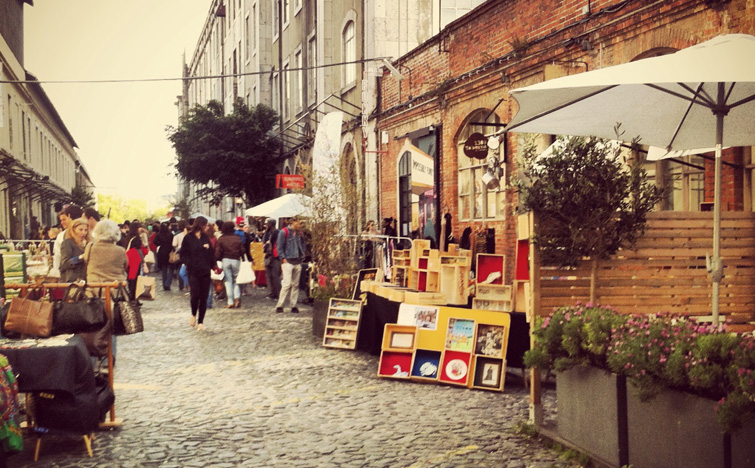
LX Factory: The new Lisbon
By Tensi Sánchez from actitudesmgz.com
Lisbon is changing. In it´s streets you can smell art and culture wherever you go. The new generations want to show to the rest of the world the greatness of the capital and the economical situation won´t be able to make the ilusion flater. LX Factory is the best example of how in times of crisis the best and most creative ideas can appear.
Alcantara was an industrial area in the XIX century located under the 25of April bridge, but nowadays this zone represents the hotest cultural area in the city. The 23.000 square meters space was meant to be demolished thanks to the Alcantara XXI project to turn it into a multipurpose area. But recession delayed the regeneration and Mainside agency took advantage of the decadent and industrial atmosphere, to rent corner for 12 euro the square meter for young artists and entrepeneurs.
The result? A huge space in which almost 80 companies related with culture, literature, art, fashion and design gather, to offer the most underground and Berlin style experience. The prizes are affordable and anybody can enjoy the hipster atmosphere.
The must places are the Cantina: an old workers dining room which incluyes food for vegetarians and or the breathtaking three floor Ler Devagar bookstore. In the night going to Lollipop disco it is a good option as long as you are included in the guests list. But there is always a chance to go to La Sala de las Columnas where different kinas of deejays will play music for a memorable night.
The Open day is an event which is held twice a year and organizates different workshops and expositions.
A different and magical place, that speaks for itself about a new Lisbon that is rosing form it´s ashes. A city that albergates the most contemporanean culture without leaving appart tradition.
By Tensi Sánchez from actitudesmgz.com
Photos by Ricardo Junqueira
Makes you want to go, right? Do it! Check out our prices here!
more info