

Lake Starnberg
By Michael Schurmann from easyhiker.co
There is no shortage of attractive hiking destinations for day trips near Munich where you are during the Oktoberfest. Both the Goldsteig and the Altmühl-Panoramaweg “top trails” are just a train ride away, and of course, there are always the Alps.
But Lake Starnberg tops the list of day trip destinations because it is by far the easiest to reach and is the scene of a titillating piece of German royalty history. (More of that if you promise to read through.)
You can go there by City Rail (the S-Bahn) in 30 minutes from Munich Central Station, and the round trip is covered by the Munich day pass which gives you unlimited access to all the city’s public transport facilities (a steal at €20 for up to five persons).
Another reason why Lake Starnberg tops that list: it won’t take you long to reach it from Starnberg station.
On a clear day, you can even see the Alps at the far end.
This far end, it must be said, is quite a long way away. Lake Starnberg is about 20 km long, and although it is quite narrow (never more than 5 km wide), the whole tour around the big pond may easily come to about 50 km.
“Road leading to Possenhofen hiking trail in Starnberger See near Munich”
For a day trip, this is clearly off the scale. But thankfully, there are plenty of alternatives.
On the right side of the lake, for example, there are two more S-Bahn stations further down the track (Possenhofen and Tutzing), so in theory, you could take the train there and walk back to Starnberg (7 km and 14 km respectively).
This was, in fact, our original plan: a walk to Possenhofen, the childhood home and favourite retreat of the star-crossed empress Sissi.
But the road to Possenhofen was so busy (even used by trucks) and so far away from the actual lake – it was practically lined with residential homes, gardens and boat houses – that we broke off our trip after app. 1 mile and returned to Starnberg.
Fortunately for us, we then discovered that the “left” (or western) side of the lake provides a much more pleasant ambiente.
A recognized hiking trail, the “König Ludwig Weg”, runs down the entire length of the lake’s west bank. That should, at the very least, ensure that you are safe from truck traffic.
No S-Bahn trains circulate down this side of the lake, but ferries take you to several of the small towns that are scattered around, including Seehausen at the lake’s southern tip.
If you have a full day, this is what you could do: Hike all the way to Seehausen and return by boat.
We only had the time for one section of this trail, however, and decided to walk the 6 km from Starnberg to the town of Berg.
Out of the station and standing in front of the lake, turn left.
The first half mile takes you past a mix of residential and recreational buildings: homes, gardens, boat houses and a public swimming pool.
After the first of two wooden bridges, however, the scenery becomes far more idyllic: swans in the lake, groups of sturdily built Bavarian women training their Nordic walking skills, young families and students skipping a boring lecture.
When you return to the asphalted road, in the outskirts of Berg, you will see some of the most expensive real estate in Germany.
Lake Starnberg, so pretty and so near to Munich, Germany’s richest city, is very much the Alpine version of the Cote d’Azur (or Beverly Hills).
After walking about 15 minutes, you will find the boat pier on your right.
“Sign leading to Koenig Ludwig Weg hiking trail in Starnberger See in Munich”Check the arrival and departure times, because the traffic back to Starnberg is infrequent and somewhat irregular, and if you miss one boat, you may have to wait a couple of hours for the next one.
If you can, make time for an excursion to the Votivkapelle (just follow the signs) another 30 minutes away.
This chapel was erected to commemorate one of the great unsolved mysteries of German history.
It stands very near the place where the mad King Louis II of Bavaria, (builder of Neuschwanstein Castle and generous supporter of Richard Wagner’s operatic works), explored Lake Starnberg in a vertical direction. (A wooden cross in the water marks the spot.)
Was it an accident? Did he commit suicide? Or was some sort of jiggery pokery involved? (For a full round-up of events, go HERE.)
On the way to the chapel, you will come across a plaque on a boat house where it says that Ludwig often set out from there to meet with his “soul mate” Sissi on the other side of the lake.
I found it strange and almost touching to see that after all these years, the Bavarians still can’t quite seem to cope with the fact that their beloved “Kini” did not fancy girls all that much.
For a less shamefaced account of the king’s life, watch Ludwig II, directed by Luchino Visconti and featuring the male model Helmut Berger as the eponymous royal, one of the campiest movies ever made: the thinking man’s Wizard of Oz.
If you do not have the time to experience Mr. Visconti’s Magnum Opus in its full Wagnerian languor of 247 minutes, do yourself a favour: sample the director’s operatic ambition here.
The latter section also features here a must-watch Bavarian-style gay orgy with folk dancing, zither music and much mutual groping.
No wonder the locals hated the film so much that they tried to have it banned when it was first released in 1972.)
Now, return to the pier where – if there is still time – you can have a coffee or a beer on the terrace of the Hotel Berg before taking the boat back to Starnberg.
If you have started your day before 12, you can still be back at your favourite Oktoberfest beer tent before the evening rush begins – and won’t miss any of the action.
Why not take a trip to Munich? Have a look at our flights here!
more info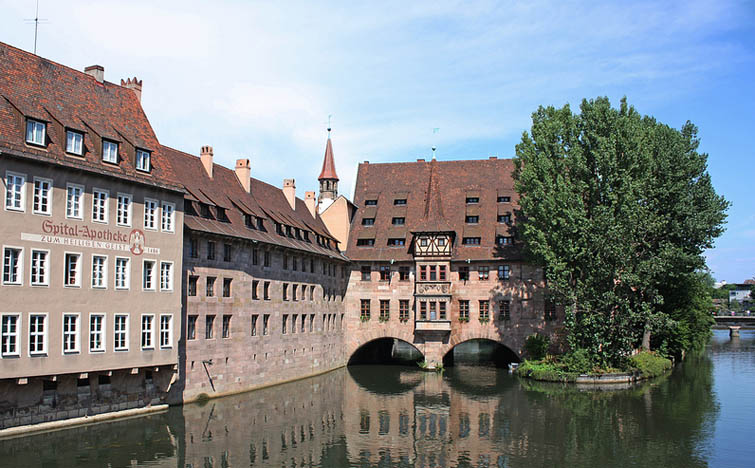
A tour through the history of Nuremberg
Nuremberg is one of those cities that allows you to organise an interesting tour through history without leaving town and no need for a time machine. A city that was bombed in 1945 and rebuilt shortly afterwards, its leading role throughout medieval, modern and contemporary history has left it with many historical attractions.
It was the capital of the German Empire between the 11th and 14th Centuries, a key centre during the German Renaissance and the main setting for the Thirty Years War (1632). Thanks to its importance during the imperial époque, Hitler made it the headquarters of the Nazi Party Congress and it was also in Nuremberg where various Nazi war criminals were tried and sentenced in Court Room 600 in the Palace of Justice .
Its history has left the city with many interesting monuments to be visited and Bavarian artists, such as Albercht Dürer have given Nuremberg an artistic heritage not to be missed. This tour offers a route through the city so you can find out all about in just one day.
Nuremberg Palace of Justice (Justizpalast)
Our tour of Nuremberg starts at this seat of judicial power, which today remains fully operational. It was here that the Nuremberg Trials took place that lasted almost one year and where the sentences handed out to some of the heads of the Nazi regime became a landmark in the history of international law.
The Court Room 600, the scene of these historic trials, is still used as a courtroom today and at the weekends, when it is not in use, offers guided tours. As an alternative, if you find the room closed, you can visit the “Memorium Nuremberg Trials” exhibition which can be found in the East Wing of the building.
German National Museum (Germanische Nationalmuseum)
Although this involves a large chunk of time and patience, as you have to queue up to get in, the visit to the German National Museum is well worth it as it is possible to see one of the greatest collections of modern German art to be found in Nuremberg, Germany and the world, all under one roof. Until 2 September, you can see “The Early Dürer”, a retrospective exhibition of the early works of German artist Albercht Dürer, a son of Nuremberg and the greatest exponent of the 16th Century German Renaissance.
On your way in or after your visit, opposite the museum entrance, is the Street of Human Rights , 29 commemorative columns that bear the 30 articles of the Universal Declaration of Human Rights . One curious thing, there are 29 columns and 30 articles (in 30 different languages) because the last column, in Spanish, had to be taken away because it was blocking the exit for the fire station. They said they’d replace it but…
Marriage Carousel (Ehekarussell)
Going into the city centre, at the foot of the Weißer Turm (White Tower), you will find a fountain that is not suitable for the recently married: the Marriage Carousel was sculpted in 1984 by Jürgen Weber. Its figures were inspired by the poem “Bittersweet Married Life” by Hans Sachs. The sculptures depict falling in love at the beginning, the routine of living together and ends up with… well, you’ll see for yourself.
Church of St. Lawrence (Lorenzkirche)
The Church of St. Lawrence, built in the 13th Century, is an example of the Hallenkirche (hall churches), the typical German Gothic churches, with three aisles of the same height. Most of it was rebuilt following the Second World War bombardments and among its curious details that catch your attention are the nets that protect the statues in the portico so that birds can’t make their nests there or the Braille information panel we came across at the entrance.
Hospital of the Holy Spirit (Heilig-Geist-Spital)
This is one of the most well-known postcards of the city of Nuremberg, photographed from the bridge opposite. On the banks of the River Pegnitz, the building was constructed between 1332 and 1339. Having fulfilled its duties as a hospital, it is currently a municipal home for the elderly.
Market Square (Hauptmarkt)
Another of the must-see spots you simply must not miss on any tour of Nuremberg, is dominated by the Church of Our Lady (Frauenkirche) built in 1358 by order of Emperor Charles IV. Its famous marketplace (particularly well-known for its Christmas Market but also offers a fresh produce and traditional food market during the rest of the year). Here you will find the Beautiful Fountain (Schöner Brunnen) that dates back to the 14th Century . The square is encircled by innumerable souvenir shops and the city tour bus stop is located right beside the historic fountain.
Bratwursthäusle
At this stage in the tour, we suggest a rest and something to fuel the stomach chance by sampling some traditional German food. Opposite the old Town Hall we found the Bratwursthäusle restaurant, where we could try the traditional German bratwurst accompanied by the equally emblematic pretzel. So sit down on the terrace and guten appetit!
Albercht Dürer’s House (Albercht Dürer Haus)
Fed and watered and after a short rest, you will be ready to walk to the highest area of the city. Before you leave the city walls, we recommend a visit to the house-museum that used to be the home of Albercht Dürer that includes in its exhibition, a chance to see the process carried out by Dürer when creating his famous etchings . Interestingly, in the square opposite the house, we discovered a curious sculpture reminiscent of one of the most well-known works by Dürer, the hare.
Imperial Castle of Nuremberg (Kaiserburg)
When you pass through the walls, you might be surprised to see gardens and orchards in the moat. The city hall rented the space out to the citizens of Nuremberg who use it as an urban vegetable patch or garden… Following the wall along for a few metres, we reach the Imperial Castle of Nuremberg from which point you can see the entire city (see the panoramic view at the start of this article). It was the residence of the German emperors from 1050 to 1571 and as well having preserved some of its original living quarters that are open to visitors, many other parts of the castle are still inhabited today.
Zeppelin Field (Zeppelinfeld)
To conclude this tour, we leave the city centre and to do this, if you haven’t done so already, we recommend you use the city’s public transport, specifically, the No. 36 bus route. You have to take this bus from the stop that is fairly near the castle then get off at the last stop on the line, that will leave you right opposite the Documentation Centre , inaugurated in 2000, the former Nazi Party Congress.
The original project for this building was to construct a half section of an amphitheatre in the style of the Roman Coliseum , with a conference auditorium in its centre. Now the building houses an interesting and modern information centre that can be visited, with a permanent exhibition documenting the history of the precinct and the ruthless abuse of power by the Nazi regime.
From there, you have to border the lake to reach the Zeppelinfeld itself: an enormous grandstand inspired by the Pergamon Altar from which Hitler directed the parades and Nazi Party congresses. Today, the area is very run-down and the city of Nuremberg only uses it for a >rock music festival held at the start of June (reminiscent of the 1970s) and a car race that takes place during the first week of July. Strange, isn’t it? Even so, you should pay a visit even if it is only to say “I’ve been there” before you go back into the city. Talking of the return, close to the Zeppelin Field there are two stops for the local train (S2) which will drop you off at Nuremberg’s central station.
Useful information
As regards transport, other than the cases we’ve mentioned, the rest of the tour can be done on foot. However, our advice is to pick up the Nürberg Cardfrom any of the city’s Tourist Offices that, for 21 €, gives you two-day access to all the museums and public transport. Children under 12 can get their card free of charge.
Another option to think about for getting around the city is NorisBike, a public bicycle hire service available to both residents of and visitors to Nuremberg. You can find more information about this service (in German) at aquí.
We’ll be there. If you want to come too, check out our flights here.
more info

The Rugged Side of Majorca
Majorca is renowned the world over for its beaches and coves, but the Sierra de Tramuntana, which rises over a thousand metres above the island’s north coast, is a veritable paradise for hiking enthusiasts. An intricate network of centuries-old tracks and footpaths has been upgraded into a set of fully-fledged walking routes traversing a surprisingly rocky landscape carpeted with dense forest. Peeping out of the clearings are a number of quaint villages and hamlets that preserve their pristine charm. A long-distance footpath, known as the Dry Stone Route (Ruta de Piedra en Seco) or GR-221, runs from one end of the range to the other, flanked by the most rugged landscapes in Majorca. The route, imbued with the region’s rich cultural heritage, covers 120 km and can be done in full or by sections. For visitors with a tight schedule, we have selected three of the best sections along the trail.
1. Ses Basses and La Trapa – the Stunning Sa Dragonera Vantage Point
The walking route starts at the Coll de Sa Gramola, a mountain pass accessible from the Andratx main road. From here, a trail heads westwards towards the caseta de Ses Basses. After that the path narrows and leads to an area with various viewpoints overlooking the sea, affording wonderful panoramic views. The trail gradually merges into the wild landscape which compounds a rugged, breathtaking setting against the backdrop of the island of Sa Dragonera protruding into the sea. After a descent flanked by vegetation, you come to an old Trappist monastery now under restoration. The project will eventually include a shelter for hikers. For the return trip, you go back the same way you came.
Recommendations:
This is an easy route, covering 15 km for the whole round trip, ideal for a morning’s hike.
Access: Coll de Sa Gramola lies 5 km from Andratx, reached via the Ma-10 main road, where there is a parking area. If you happen to come in two cars, you can extend the excursion beyond La Trapa as far as Sant Elm, where you can park one of the cars beforehand. The walking distance from Coll de Sa Gramola to Sant Elm is 13 km in all. Remember to take water as there are no drinking sources on the way and little shade.
2. Camí de s’Arxiduc – a High-Flying Lookout Between Valldemossa and Deià
The excursion begins at the Charterhouse of Valldemossa, the former residence of King Sancho I of Majorca. Exit the village of Valldemossa following the white and red markers of the GR-221 along a stony path with a steep gradient that ends at the Es Cairats shelter, which is still closed. It should be noted that original route of the GR-221 was very different from the current one as it used to go over the summit of Talaia Vella, from where it joined up with the Camí de s’Arxiduc. On the new route, old lime kilns are visible on the ascent leading to Es Cairats, as are charcoal kilns and the small shelters once inhabited by those in charge of managing resources in the magnificent holm oak woods.
After the shelter, the footpath turns into a track and you soon come to a wild, open area. The GR-221 markers lead to the summit of Puig Gros, the Pla des Aritges plain and Es Caragolí, where the route finally links up with the panoramic Camí de s’Arxiduc. Before taking a detour to descend towards Deià, it is well worth walking a few extra yards – even though this involves going back on our tracks – along this emblematic route, as it runs along the ridge of the mountains. It was commissioned by the Archduke Louis Salvador of Habsburg-Lorraine in the late-19th century for the sole purpose of being able to enjoy the scenery.
Recommendations:
While only 13 km long, the route has a difficulty of medium-high, on account of the slopes and terrain, which is very rocky and steep in some stretches.
Access: You can leave your car in Valldemossa and take the bus back from Deià.
3. From Sóller to the Monastery of Lluc – A Weekend in the Mountain Heartland
One of the most spectacular, varied, accessible and best appointed sections of the GR-221 is the one that connects the historical town of Sóller to the Monastery of Lluc. It covers a distance of 35 km and can readily be divided into two stages – of 19 km and 15 km each – with an overnight in the Tossals Verds shelter.
Stage 1 – On the first day, the GR-221 markers point you from the centre of Sóller to the bucolic Biniaraix gorge. This involves a pronounced accumulated slope, leading up to the Coll de l’Ofre and the Cúber dam. From here, the more seasoned hikers can proceed to the Tossals Verds shelter via the new Pas Llis bypass, with an added ascent and a brief, simple equipped pass. The alternative is the old route which goes around Coll des Coloms and does not entail any difficulty.
Stage 2 – After regaining your strength in the shelter, you proceed along the GR-221 towards the panoramic areas of Coll des Prat and Coll des Telègraf. From here, a long descent leads you to the monastery along a winding path which snakes through a holm-oak wood featuring old but recently restored ice pits.
Recommendations:
The trek lasts two days and the difficulty level is medium to high, as it includes steep slopes – with a daily accumulated slope of over 1,100 metres – and prolonged descents along tracks. The terrain is rocky and requires mountain footwear, in addition to trekking poles. While the path is signposted with posts, waymarkers and paint marks, it is advisable to take your own hiking map, such as the one published by the Editorial Alpina. You should also book overnights at the Tossals Verds shelter in advance, as capacity is limited (website).
Access: You can get a bus to Sóller from Palma, or you can travel on the old Sóller railway, which has been plying the route daily since 1912. You can take the L330 line bus to make the return journey from Lluc to Palma.
Don’t wait to discover the rugged enclaves of Majorca – check out our flights here.
Text by Sergio Fernández Tolosa & Amelia Herrero Becker of Con Un Par de Ruedas
Photos by Con Un Par de Ruedas
more info
Julio Cortázar and Rayuela's Paris
Even the experts consider it an ‘antinovel’, there is no doubt that Rayuela influenced many generations since it was released and, because of it, Julio Cortázar became a literary benchmark whose centenary of his birth is celebrated this year. If Maga and this unparalleled adventure in Paris also fascinated you, our route through the French capital will help you remembering the most remarkable moments in Horacio Oliveira’s history.
"¿Will I find Maga? Many times I just had to look out coming by rue de Seine, the arch that takes you to Quai de Conti, and only the olive and ash light floating on the river let me distinguish the forms, its tiny shape by Pont des Arts, sometimes walking from side to side, sometimes stopped at the iron parapet, leaned against the water. And it was so natural to cross the street, ascend the steps on the bridge, get in the tiny waist and get closer to Maga smiling unsurprisingly, convinced like me that a chance encounter was the less casual in our life, and that people who arrange dates is the same that needs ruled paper to write each other or that pushes from the bottom the tooth paste”
Quai de Conti: The novel, like our route, starts at rue de Seine, Quai de Conti and Pont des Arts, places where Horacio y Maga met each other, with a special symbolism for the author considering the centric location of this part of the route that take us along the left side of Seine river. Our protagonist also mentions the library Mazarine, located at the other side of the arch and the most antique library in the country.
Pont des Arts: As a connection between Institut de France and Louvre (previously known as Arts Palace), you can find the centric iron bridge where Oliveira got drunk at the first part of the book. Now full of lockers promising everlasting love, the panoramic views over Cité island and all the bridges is one of the most beautiful pictures you can take of the city.
Louvre Museum: Even Rayuela is full of cultural references, when we are talking about visual arts Louvre museum is the only reference Cortázar gives us about this city on this field. The most visited arts museum in the world appears on our way after taking Pont des Arts. This place is a must to anyone because of its wide collection and masterpieces such as “La Gioconda” by Leonardo da Vinci and a stunning building including, since the 80s, a great glass pyramid that you should visit.
Rue du Jour: The latest partners of Horacio at the city, homeless people, feed themselves thanks to the soup dish that they receive here. By the church Saint Eustache, people in need receives food at this street, located at Les Halles, a gardened area right in the city centre where there are two more places we will pass by.
"Au chien qui fume" restaurant: Located at Rue du Pont Neuf, this is one of the cafés named at chapter 132 and is also a meeting point for Etienne and Horacio on the way to the hospital to visit Morelli. This is a typical French restaurant, with an elegant and traditional decoration and a careful cuisine selection. Following this street we find the next stop…
Pont Neuf: Even it name means new bridge, it’s completely the opposite, and it’s the oldest. Here we say goodbye to Horacio and Maga in this route. Made of arches, the bridge took almost 30 years on the making and during the 18th century it was the centre of crime and commerce in the city. Passing by the bridge we will go back to the left side of the Seine, where we will stay.
Rue Dauphine: Even it’s part of a dispensable chapter, Pola, Horacio’s French lover, lives in this street. The street starts after Pont Neuf, and it was named after France’s dauphine, Henri IV’s son.
Rue de la Huchette: This is another place where Horacio thinks his lover can be at. A must-visit pedestrian street with many famous places like the theatre Huchette and Caveau de la Huchette. We pass through from the boulevard Saint-Michel until we reach Rue du Petit-Pont, before we get to the Notre-Dame cathedral.
Notre Dame: Chance makes the protagonists meet again at this iconic landmark of the city, one of the most beautiful and most visited French gothic cathedrals, which was finished on 1345 and is located at the Cité island. Who hasn’t heard about Notre Dame and its famous hunchback? Either as the Quasimodo by Victor Hugo or by Disney, the gargoyles are part of the collective imaginary
Rue du Sommerard: The street where Horacio Oliveira lives and one of the oldest in the city, which during the Roman age took to the baths at Cluny. Next to the famous Saint-Germain Boulevard, Sommerand is nonetheless more relaxed and perfect to take a relaxed walk.
Rue Valette: This is a magic place for our protagonists, in one of the hotels here they consummate the relationship for the first time and here is also where Horacio took Pola. Rue Valette is at the quarter of Sorbonne University and follows the Rue de Carmes, the meeting point for students.
Rue Monge: One of the places where is believed Maga lived after separation and the death of his son Rocamadour. This is a important street located at the university area on the Paris district nº 5.
Rue Monsieur Le Prince: The incomprehensible chance also takes place at this street, which used to be a road and leads to the Edmond Rostand Square along the Saint-Michel Boulevard. Notice also that Polidor restaurant, where the story of Cortazar’s "62 A Model Kit" takes place, is also here. We pass by this place if we go to Odeon.
Rue l’Odéon: Remember here, with Horacio, parts of his relation with Maga, eating at Carrefour de l’Odeon and riding the bike by Montparnasse. The impressive Odeon theatre gives the name to this street and neighbourhood, full of life by night and day, where we can find all kinds of bars, cafés and restaurants. From here, take Saint-Sulpice Street to arrive to the next stop.
Rue de Tournon: This is the street where we walk back to Madame Trépat house, with Horacio. Even traditionally it was full of old bookstores, many luxury fashion shops moved here on the past few years. It’s one of the most prestigious streets, from the Senate and across Saint-Sulpice street, which lead us to the end of this route. Mario Vargas Llosa lived here too.
Montparnasse cemetery: The last stop in this route is also the location at the last chapter of Rayuela, where Horacio takes a little paper and also where Julio Cortázar was buried. At the hearth of Montparnasse neighbourhood, this was inaugurated on 1824 and is the second in the city, with many remarkable people resting here along with the author, such as Simone de Beauvoir, Samuel Beckett or Jean Paul Sartre.
Image from Henri Marion
A place well worth discovering! Check out our flights here.
more info