

The Ria de Muros e Noia , the Port of Santiago de Compostela
The Ria de Muros e Noia is one of the Galicia region’s least built-up coastal areas, and also one of the most beautiful. Fishing boats landing delicious, shellfish, white sandy beaches with good surfing, all framed by green hills with a riot of vegetation –it’s definitely worth a visit. Here is a route you might consider.
Mt. Louro and the Xarfas Lagoon
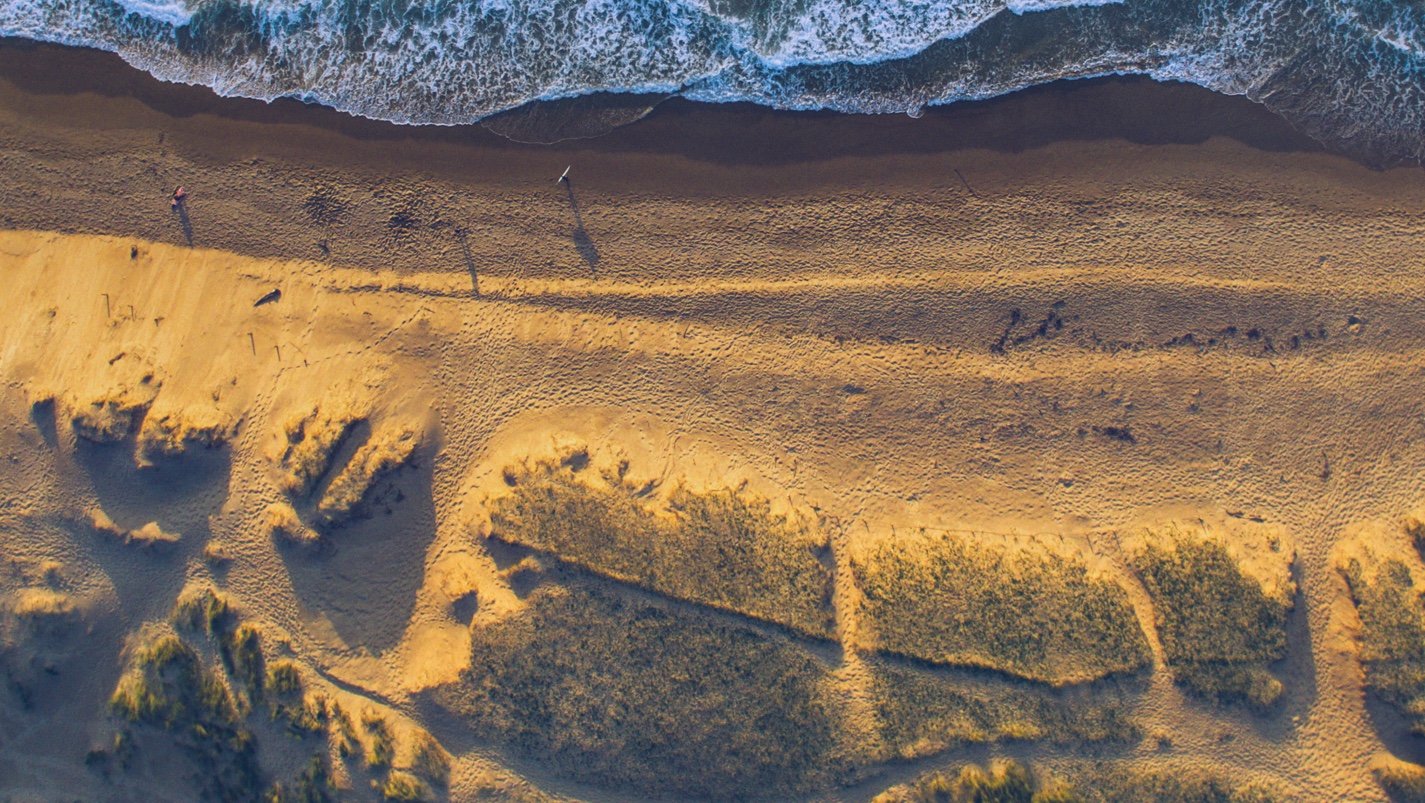
Starting from the northern extreme of the estuary, between the Costa da Morte and Muros, you can stand atop Louro mountain, a 241-metre high granite block, and feast on the views of the Ria de Muros e Noia and the Lagoa de Xarfas with its fabulous Area Maior beach. The surrounding –hills, dunes, beach and the lagoon—boast a wealth of flora and fauna. There’s even an observatory for watching migratory birds.
Muros
Heading south we come to the town of Muros, founded in the 10th C. , and now featuring modest fishermen’s houses next to lordly mansions from bygone times. A stroll the town in the late afternoon can be timed to coincide with the arrival of the boats in the evening after a day’s fishing. The fish is put up for sale immediately on the dock, which is also an interesting spectacle to watch. And it means your shellfish dinner will be fresh and delicious. You won’t be disappointed by any of the restaurants under the arches near the water’s edge.
Just three kilometres away on the road to Noia is the Muíño de Mareas do Pozo do Cachón, a flour mill powered by the tides, built in the last quarter of the 19th C. There is also an interesting museum.
Noia
Noia is the biggest town in the estuary, and is only 36 km distant from Santiago. According to tradition, it was named for Noah, who is believed to have settled there after the Biblical flood. The city’s coat of arms shows an ark and a dove bearing an olive branch.
The old quarter features two churches built in the local version of the Gothic style: San Martiño (15th-16th C.) and Santa María a Nova (14th C.), the latter with a fascinating collection of about 500 tombstones. The 16th C. convent of San Francisco may also be visited, and the town is replete with stately mansions, such as the Casa da Xouba, the Pazo Dacosta (or Casa de Rivas), and the Pazo Forno do Rato. In the Obre district the pazos (mansions) of Pena de Ouro and Bergondo are worth a visit.
Some five kilometres from de Noia, across the Tambre, we come to the Ponte Nafonso, a bridge built during the 12th C. reign of King Alfonso IX of Leon and Galicia. It consists of a score of pointed arches lying on granite ashlars. The setting against the sea and mountains makes the sight of the bridge all the more spectacular
Castro de Baroña
On the south side of the estuary, next to the fishing village of Porto do Son, is the Castro de Baroña, an Iron Age Celtic settlement, with a score of round or oval stone cottages, once thatched, on a small peninsula. The archaeological remains and the wonderful landscape make it a worthwhile visit.
Corrubedo Dunes Nature Park
Between the Ria de Muros and Noia and that of Arousa, to the south, lies this lovely park with beaches, dunes, fresh- and salt-water lagoons, wetlands, and even megalithic remains. One of the main attractions is the “moving dune”, a restless pile of sand about a kilometre long , 200-300 meters wide, and 20 metres tall.
Some Further Recommendations
Though the quickest way to explore the Muros and Noia estuary is by the AC-550 coast road, we recommend side trips into the surrounding hills to get the best views.
For lodging there are numerous country inns and guest houses on both sides of the water, most of them in old and typical buildings. A particularly unusual place to stay is the hotel Pesquería del Tambre, in the Tambre river valley on the site of and old hydroelectric dam transformed into a nature hotel by the architect Antonio Palacios.
Check out our flights to Santiago de Compostela and head west to the sea!
Text: Isabel y Luis Comunicación
Pictures: Turismo de Galicia
more info
At the Beach and in the Desert, without leaving Eilat
It is the coastal and tourist resort par excellence. Eilat is the southernmost city in Israel and lies on the border of Egypt’s Sinai Peninsula. From this bustling city straddling the sea and the desert you can see the mountains of Jordan and Saudi Arabia on the horizon. Four countries come into view with but a single glance – a unique setting.
Once you’ve got your bearings, it’s time to soak up this torrid resort where the thermometer rarely drops below 20 degrees. Indeed, it stays above 30 degrees most of the year around – well, even a bit higher in summer. Oddly enough, it can even happen that, while it is snowing in Jerusalem (quite a common occurrence in winter), you can be roasting in the sun in Eilat, just a four-hour drive away (or one hour, by plane, from Tel Aviv).
Apart from being spoilt by the warmest temperatures, what draws most visitors to Eilat is the Red Sea. Being able to swim in clear, warm, sky-blue, richly-coloured waters is a luxury in a country covered for the most part by such deserts as the Negev, Arava or Judea.
The city’s infrastructure is also a boon. It is designed for the holiday-maker’s benefit, with all the ingredients that a tourist thirsting for leisure, sun and sea could wish for. It boasts a seaside promenade lined with shopping centres and stores brimming with special offers for all kinds of tax-free souvenirs (Eilat is a free port). There are restaurants everywhere, a variety of attractions, particularly for children and families, and a throbbing nightlife with entertainment for those seeking all-nighters. And, most importantly, a lavish supply of holiday hotels of all categories with swimming pools, spas, beach access and all the comforts visitors could need to switch off for a few days.
But, I should emphasise – what visitors to Eilat enjoy most is the coastline studded with marine life. The Red Sea is an underwater paradise for lovers of all types of diving, from the pros to the amateurs.
Even children can take the plunge and dive with dolphins, which is perhaps the activity that both children and adults request most during their stay in Eilat. The experience is well worth trying at the dolphin-reef. It’s easy – all you have to do is put on a tight-fitting wetsuit, adjust your oxygen bottle properly and take everything you need to breathe freely under the water. And, pay attention to the instructor who is going to escort you on your underwater adventure… and let yourself go!
You’ll be taking in the colourful marine wildlife and coral reefs as a plus to the experience of diving down to conquer the seabed with the odd dolphin as your host, who is more than likely to perform a few pirouettes for its prized visitors – a fascinating experience!
Wait! There’s still more – instead of diving with dolphins, if you’d prefer to have your picture taken with sharks, all you have to do is head for the Underwater Observatory Marine Park, an interactive aquarium, most of which is in the open air, which boasts Shark World, the largest shark pool in the Middle East, covering a surface area of 1,000 cubic metres. What visitors enjoy most is when the staff come to feed the sharks. This is undoubtedly the best time to come face to face with these huge, dangerous marine animals. Apart from the shark pool, the aquarium also features a children’s adventure park where infants can stroke and feed various kinds of fish and be treated to futuristic screenings such as “A Journey into the World of Sharks”.
But the sea is not the only attraction in Eilat – the sky is also captivating. It is right now, in spring, that millions of birds fly over that area. In fact, according to the experts, up to 500 million of them! They fly in a south–north direction, the opposite of the tourists, as part of the spectacular spring migration, an essential event for all ornithologists.
Eilat also stands out for its cultural offerings – could it be otherwise? These include such celebrated events as the Chamber Music Festival, an international classic held each year in February. Also in the vicinity is the nearby Timna Park, an exotic attraction where all kinds of adventure sports can be done in the middle of the desert while viewing landscapes worthy of Mars.
What more could you ask for? Check out our flights here.
Text and images by Nani Arenas
more info
Electronic Music Hits Zürich’s Quiet Streets
For more than 20 years, thousands upon thousands of people have flocked to the shores of Lake Zürich to celebrate the Street Parade, one of the largest urban festivals on the planet geared to a grand display of love, peace, tolerance and freedom. For just one day, the quiet streets of this Swiss city will pulsate with electronic rhythms and be literally inundated by techno fans and DJs, making for an electrifying atmosphere.
The parade normally takes place on the second Saturday of August, but this year the date has been changed. The streets of Zürich are currently undergoing repair work and, so as not to disturb the flow of the technoparade, the date has been postponed three weeks to 29 August. The dates of the city’s other landmark summer festival, the Zürcher Theater Spektakel, have also been moved. This festival of the scenic arts has been brought forward and will be held from 6 to 23 August, to avoid it coinciding with the Street Parade.
A Little History
At its debut in 1992, Zürich’s Street Parade was attended by a mere one thousand people. But, as of 2001, it has become the largest open-air festival of electro and the city’s biggest annual event. Attendance has approached one million people in the last five years, although this has not posed any safety issues. It is worth recalling that, on 24 July 2010, a stampede at Duisburg’s Love Parade led to a crowd disaster which caused the deaths of 21 people and left about 500 injured. This sad spectacle has conditioned the organisation of such parades forever, with the emphasis now being on infrastructure and safety measures. For this reason, and on account of its calling as a peace festival, everyone abides by the rules and Zürich’s Street Parade is regarded as one of the safest mass crowd events.
Street Parade – Magic Moments
The leitmotif of this year’s parade is Magic Moments and the official anthem was written by the Swiss music producer, Alex Price. A large number of DJs will be participating in the event. They include some great international stars and will be contributing their work free of charge, as a result of the respect elicited by the festival on an international level, as well as its good organisation and the not-for-profit spirit of its organisers.
The Picturesque Parade Route
The parade begins at 1 p.m. at the Utoquai jetty in the district of Seefeld. From here, it will head to the area around Zürichsee – Lake Zürich – one of the most spectacular spots in the city. It then continues along Bellevue Street and Quaibrücke, and will end at Hafendamm Enge around midnight. The march-past runs for 3 kilometres, taking in some of the city’s most picturesque and interesting areas. It will be escorted by 30 trucks loaded with sound equipment, loudspeakers, dancers and DJs, each one representing a prominent Swiss or foreign club. There will also be six fixed stage settings at points along the riverbank route, each with its own programme.
A Long Dancing Weekend
Make the most of your stay in Zürich and also visit the other, albeit smaller-scale, events and celebrations of all kinds – of which there are about a hundred – hosted in Zürich’s various quarters. One of the most emblematic parallel festivals is the legendary Lethargy, in Rote Fabrik. Another interesting option is to visit Hiltl, inscribed in the Guinness Book of Records as the world’s oldest vegetarian restaurant – which opened in 1898 – while simultaneously enjoying one of the best clubs in town.
Some Pointers
- While the event is admission-free, buying a drink can be expensive and complicated. Be cautious and take at least one bottle of water with you to avoid dehydration.
- Don’t be shy and dress up to impress. It’s the right time to let yourself be carried away by your whim, so try on the most outlandish garb. But, make sure it is cool and comfortable because the day will be long and hectic.
Summer marches on and the party continues. They are well aware of that in Zürich. Don’t let this chance to enjoy the best parade pass you by. Check out our flights here.
Text by Scanner FM
Images by Street Parade
more info
Stockholm According to Millennium
The writer and journalist, David Lagercrantz, took up the challenge of continuing the trilogy begun by Steig Larsson, having authored the fourth novel in the Millennium series, That Which Does Not Kill. In addition to instigating Scandinavia’s black novel phenomenon, this popular trilogy featuring Lisbeth Salander and Mikael Blomkvist as the main characters has turned into a fascinating alternative guide to the city where the action is set – Stockholm.
7-Eleven
While not a particularly interesting spot for sightseers, establishments like 7-Eleven, at number 25 Götgatan Street, can always comes in handy. As a regular, it is here that the hacker and social recluse, Lisbeth Salander, sources the two essential ingredients of her pernicious diet – frozen pizzas and cartons of Marlboro Light.
Ikea
Ikea is a veritable institution in Sweden and Steig Larsson could not afford to ignore it in his trilogy. It features in the second instalment, when Lisbeth Salander turns up at the Kungens Kurva premises (the largest in the world) to buy furniture for her new apartment. Larsson provides such a detailed list of the purchase – Karlanda sofa, Galant desk, Bonde bookshelves… – that anyone wishing to faithfully replicate Salander’s flat interior could easily do so.
Kvarnen
Among Lisbeth Salander’s few friends are the members of the heavy metal group, Evil Fingers, who she usually meets up with at Kvarnen on Tuesday evenings. Located at number 4 Tjärhovsgatande Street and with over a century’s standing, it is one of Stockholm’s oldest taverns, offering such noteworthy traditional Swedish dishes asköttbullar (meatballs) and surströmming (herring).
Lisbeth Salander’s House
In The Girl Who Played With Fire (2008), Lisbeth Salander moves to a luxury apartment at 9 Fiskargatan Avenue. This block, built in 1910, stands out in Stockholm’s skyline for its green metal roof. Salander enjoys no fewer than 21 rooms in her new abode, as well as tempting views of Djurgården island and Saltsjön Bay!
Mikael Blomkvist’s House
It requires no feat of the imagination to picture Larsson walking in front of 1 Bellmansgatan Street and fantasise settling down in such a privileged enclave. His desire, at least in the fiction tale, materialised when he had one of his main characters, Mikael Blomkvist, move into the attic, a 65m2 apartment flooded with light, affording beautiful views over Riddarfjärden Bay, Gamla Stan and the Stockholm City Hall.
Mellqvist Kaffebar
At 78 Hornsgatan Street, the Mellqvist Kaffebar is not just one of the cafés most frequented by the protagonists of Millennium. It was actually one of the author’s favourite spots, too. There are even those who claim that, between one café and another, it was there that Larsson wrote more than a chapter of his successful trilogy. Indeed, the journal, Expo, of which Larsson was the director, was housed on the floor above it.
Mosebacke Torg
Just a few metres from Salander’s new apartment lies the Mosebacke Torg, one of Stockholm’s loveliest squares. Sited on the square is the Södra Teatern, the city’s oldest theatre, built in 1859. It is in the theatre bar that Lisbeth usually meets Annika Giannini to exchange confidences over a few beers. The Mosebacke Torg also houses one of Stockholm’s last-surviving telephone boxes still in service.
Millennium’s Editorial Office
Located on the corner of Götgatan Avenue – one of the busiest arteries in the Södermalm district – and Hökens Gata Street, the editor’s office of the Millennium journal is housed on the floor above Greenpeace’s headquarters. Staunch enthusiasts of the trilogy are likely to be disappointed when they realise that, while the offices of Greenpeace are indeed located on that corner, the upper floors of the building are all just apartments.
Samirs Gryta
Enthralled with their couscous and mutton stew, the Samirs Gryta Syrian restaurant is a favourite among the Millennium editorial staff. The exact address of this fictitious eatery is never divulged in any of the instalments but, in terms of its appearance, Steig Larsson was probably inspired by the Indian restaurant Dado (Tavastgatan, 28) and the adjoining Lebanese restaurant, Tabbouli (Tavastgatan, 22).
Stortorget
Stortorget is the square where Dragan Armanski catches sight of Lisbeth Salander shortly after being hired by Milton Security. Stortorget is one of Stockholm’s historic sites as here, in November 1520, the Bloodbath took place, when Danish King Christian II had hundreds of members of the ruling classes executed in order to seize control of the country. Also in Stortorget is the Nobelmuseet, the Nobel Prizes museum.
The Stockholm City Museum offers a fascinating tour of the city inspired by the Millennium trilogy. Click here for further details.
Ready for an exciting journey through the trilogy? Check out our flights here.
Text by Oriol Rodríguez for ISABELYLUIS Comunicación
Images by Holger Ellgaard, I99pema, Kirsty Komuso, Arild Vågen, Mstyslav Chernov
more info